
We are wired for connection

Yesterday, I finished reading Brene Brown’s “Braving the Wilderness,” which is about our desire to belong and have since found myself pondering what that means and what it means to crave connection.

As human beings, we are wired for connection. None of us can get through life alone. We need other people to help us navigate the sometimes choppy waters of life. And that is okay. We as humans are interdependent upon others. That is different than being codependent, which means we cannot function on our own and that our thinking and behavior is organized around another person. But Brown’s book on belonging and connection has left me wondering what that all means.

Belonging requires us to be ourselves. It is different than fitting in, which means we act in ways that we hope garner approval from others. Belonging requires us to sometimes stand alone. It also requires that we first belong to ourselves, and that, it seems can be tricky. How do we first belong to ourselves so that we can feel as though we belong in the world? Belonging to ourselves requires that we be true to ourselves, our values and convictions.
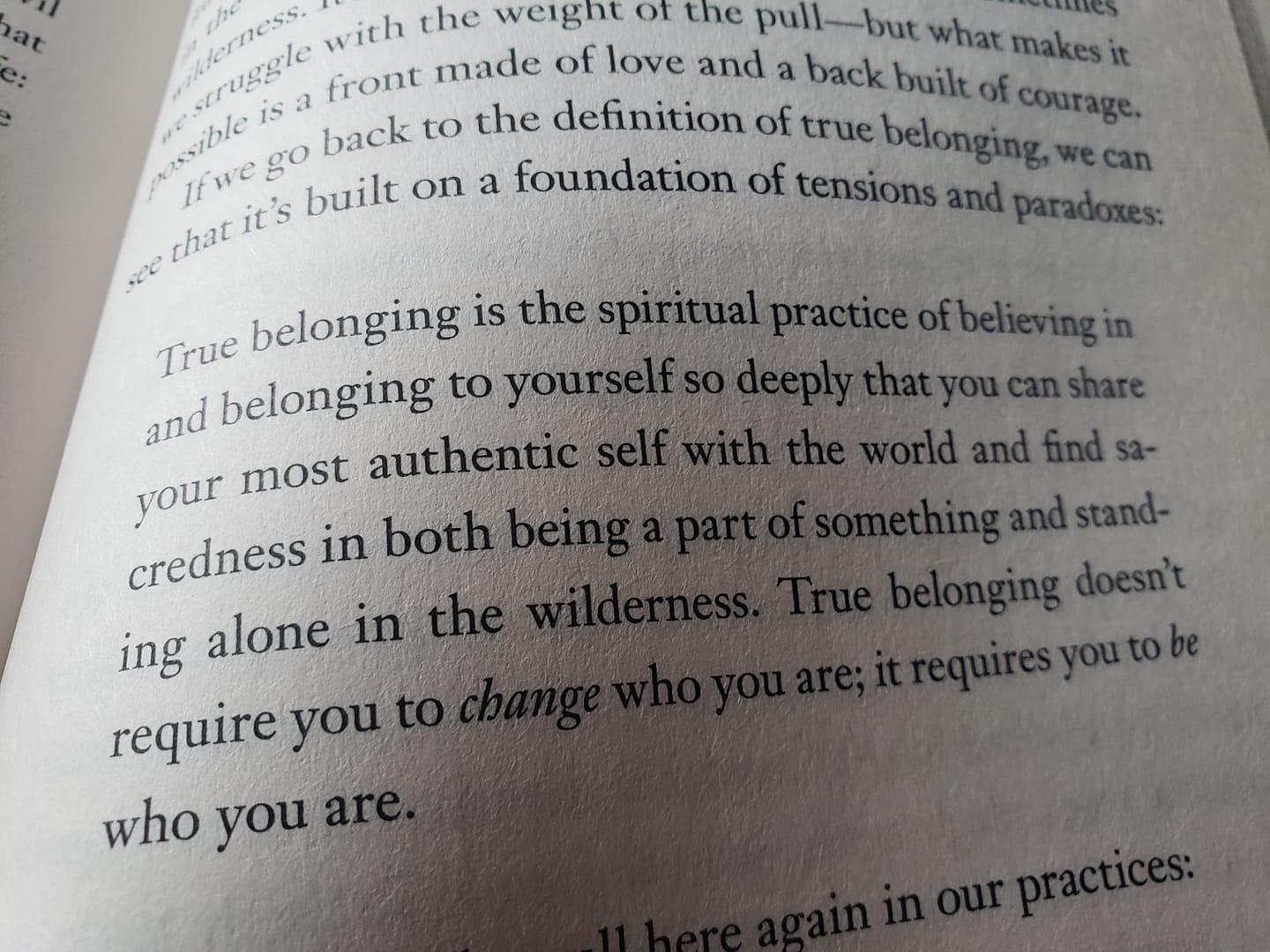
Read that: True belonging doesn’t require you to change who you are; it requires you to be who you are. That means that we do not massage our values to fit in with any particular group or sect. That means that we hold true to our values, whatever they may be, even in the face of adversity. True belonging requires us to dig deep and really come to know ourselves as the sometimes flawed, perfectly imperfect beings that we are. Yes, that may be frightening, but if we do not belong to ourselves how can we possibly feel as though we belong anywhere in the world?

I have always craved connection, true, deep emotional connection. I have long craved true belonging. Yet I find it scary to be vulnerable with others, and even more so with myself. Brown says in her many books that vulnerability is our most accurate measure of courage. I sometimes wonder if I have the courage to be vulnerable not just with others so that I may be truly seen and heard, but with myself so that I can come to better know and trust myself. Vulnerability is hard. And scary. But without practicing vulnerability, how can we come to know ourselves or let anyone else truly know us. We want to belong yet fear sometimes gets in our way of letting that really happen.

How do we get there? How do we give ourselves permission to be vulnerable with ourselves and with others? We do so by getting to know who we are through the hard work of self-evaluation and self-assessment. This may mean therapy (which I participate in). We do this by allowing ourselves to be seen and heard by stating our values and convictions and by holding true to what we believe. True belonging does not require us to change who we are; it requires us to be who we are.

So, who are we? Who am I? I am a person who values family and loyalty, who values emotional intimacy, who values meaningful conversation. I am a person who believes in science and data and fact-based information. What values do you hold? Are you true to your values? Are you true to yourself when interacting with people from different groups or sects? Do you belong to yourself?

~ Karri Christiansen, MSW, LSW, CADC, CCTP
We are wired for connection

None of us can read minds

We live in chaotic times. The COVID-19 pandemic still is raging. There is an unjustified war in the Ukraine. Suicides and drug overdoses are skyrocketing. Peoples’ mental health is declining. And so many of us fear sharing what really is going on with us out of concern about how we will be perceived and stigma surrounding mental health, substance use and eating disorders.

All of this may leave us hungry for some kind of help, be it physical comfort or assistance with our mental health. What happens, though, when that help we need is desired from our loved ones and it is not forthcoming? What happens when our most basic need for compassion and understanding goes unmet?

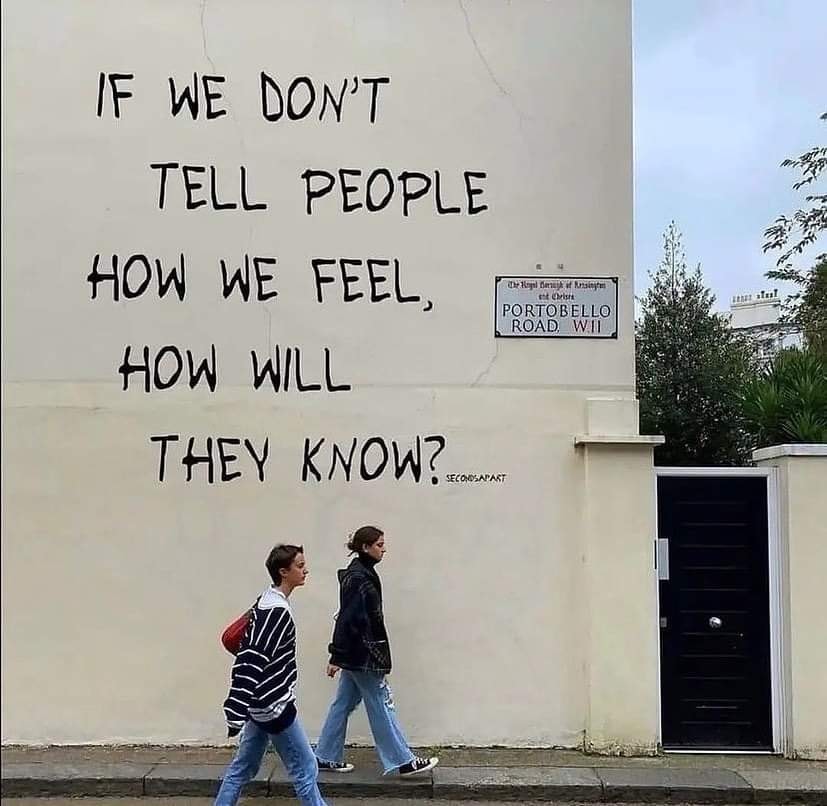
Certainly this may happen because some people are emotionally unavailable or emotional vampires, but sometimes this happens because we who suffer assume our trusted others know how we feel and we believe that they should automatically know what we need. As I frequently tell my clients, it does not matter how long you have been with or known your trusted other, be it a partner, parent, sibling or friend, your person cannot know exactly what you are feeling and what you need unless you tell that person. It does not matter if it has been 10 days, 10 weeks, 10 months or 10 years. Unless you share what you are feeling and what you need in that moment, your person is only guessing.

Why are so many of us often reluctant to share what we’re feeling? Perhaps it is because in the past, doing so has left us feeling unheard or unseen. Perhaps we have felt rejected. If that is true for you, that leads me to wonder if perhaps you have shared your feelings, needs, wants and desires with the wrong person or in a way that left you wanting for more.

What might happen if you used your “I feel … ” statements to share what you are going through emotionally and what you need in that moment. Those statements can help your person better understand exactly what you are feeling and why and what you need in terms of comfort, compassion and understanding. It is perfectly acceptable to say something along the lines of “I feel X because Y and I need Z from you now in this moment.” Hopefully by doing so, your person gains a better understanding of not just of why you feel a certain way but what he or she can do to help.

If the COVID-19 pandemic has taught us anything, perhaps it has given some of us the insight to know that it is okay to not feel okay. The question that remains is, what can you do about it? One thing you can do is share your feelings with a trusted other. Tell that person exactly how you feel and why and what you need. Your feelings, your needs are valid. Whatever you are feeling is okay. Happy, mad, sad, glad, other. Your feelings are acceptable. It is okay to share them.

We like to think that because we have known someone for years, that that person should know us well enough to simply take care of our needs without prompting. That is not necessarily always true. Your people cannot read your mind. Some are better than others at reading affect and body language, but others may need some help understanding what it is you are feeling. It is okay to share with those people what you are feeling and what you need.

If you want to be seen, heard and understood you have to summon the courage to be vulnerable and share your feelings. If you want your needs to be met, it is okay to voice what those are and how you want those needs met. Yes, it would be lovely if our people could do that without prompting but not everyone is able to do that. Meet those people in the middle by sharing with them. Perhaps by doing so, you will find that you feel seen and heard.

~ Karri Christiansen, MSW, LSW, CADC, CCTP
None of us can read minds

Love thy neighbor

I am reading Brene Brown’s “Braving the Wilderness” and am struck by, well, pretty much everything she writes in the book. One of the ideas that has resonated most with me is the idea that it is hard to hate people once we really get to know them.

In this age of social media, it can be easy to focus on all the hatred and vitriol. Social media can serve the purpose of helping us stay in some way connected to friends and family, but also can open us up to what seems to be the collective anger of the masses. We can choose to step away from that anger, hatred and vitriol by choosing not to engage or read posted comments. It seems difficult to engage with people on social media in thoughtful conversation as so many people seem to double down on their rage and insist on being indignant. What happens, though, with those we really know outside of social media (meaning, in real life) when we invite people to share with us why they think in a certain way or believe certain ideas?

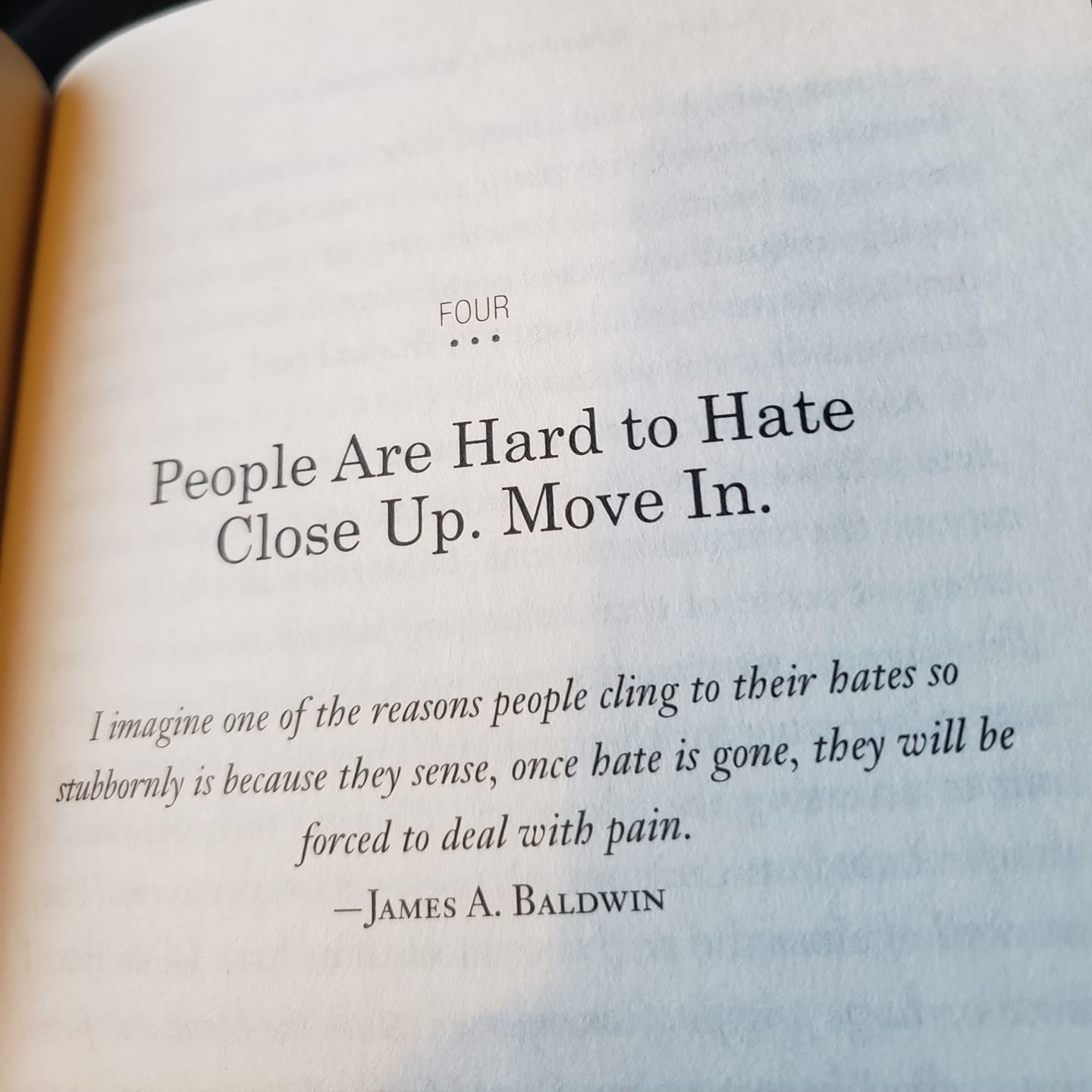
It is hard to hate people if we invite them to share with us their stories.

If we muster the courage to speak with people face-to-face and one-to-one and invite them to share with us their stories, we give ourselves the gift of learning who they really are. When we invite people to share with us what caused them to think a certain way or believe certain ideas, we give ourselves the gift of making a connection with someone who may think differently than we do. We open ourselves up to new perspectives. That does not have to mean that we change our minds; we can still disagree with those people. It does mean that we have open up a line of communication and better understanding.

It can be difficult in this age of social media to make the decision to chat with people in real life and may not always be feasible. But I suspect some of us have “friends” on social media who live not far from us who we may be able to meet for a cup of coffee somewhere to discuss the events of the day. Yes, doing so may be scary or even inconvenient but doing so helps us grow as human beings and affords us the opportunity to learn who those “friends” really are.

Hate is borne of ignorance. The antidote to hate is not just love but respect and understanding. One of the ways we can combat hate is by embracing opportunities to get to know not just the people in our circles, but those who live outside of those circles. It is hard to hate people once you move in. Move in.

~ Karri Christiansen, MSW, LSW, CADC, CCTP

Love thy neighbor

We all are perfectly imperfect

I recently have found myself working with several clients who are struggling with perfectionism and how that affects their lives. So many of us struggle with perfectionism, stemming in part from our childhoods and our need to be loved. What happens when we come to the understanding that we do not have to be perfect in order to be worthy of love and belonging? What happens when we let go of our need to be perfect?

Perfectionism often is borne of shame and so often is something we engage in because we feel we have to be perfect in order to be worthy. How has perfectionism manifested in your life? Do you tend to go above and beyond the call of duty to prove you are worthy at work or in your relationships? Do you bend over backwards for other people for fear that if you do not you will not be liked or loved?

Many people who struggle with perfectionism often find themselves also struggling with depression and anxiety, as well as a constant feeling of being disappointed or let down. It is good to remember that nothing in life is perfect. We as human beings are perfectly imperfect yet still worthy of love and belonging.

How is perfectionism playing a role in your life? Is it holding you back from engaging in activities because you feel you have to be perfect in order to enjoy them? Do you procrastinate on projects because you feel that something has to be done perfectly? TED Ed recently issued this report and quiz on perfectionism … https://ideas.ted.com/quiz-is-your-inner-perfectionist-running-your-life/ .

I encourage you to take a look at this article and quiz to see if you find yourself in it. Many of us engage in perfectionism but if we stop to think about how perfectionism is affecting our lives it can be easier to come to the understanding that we do not have to be perfect. Perfection is unattainable. Perfection is boring. You may find that if you constantly strive for perfection, you often will find yourself feeling disappointed.

I am not saying that we should strive for mediocrity. It is good to strive to do your best, at work, at home and in your relationships. It is good to do the best you can with what you have right now. That does not mean you have to be perfect. Remember that doing your best is all anyone can ask for, even you.

You can begin to let go of perfectionism by offering yourself grace and compassion for being the perfectly imperfect human that you are. We were not created to be perfect and it is good to remember that despite our flaws, we are worthy of love and belonging. You do not have to be perfect to be loved. You are loved because you are imperfect. You are loved because you are human.

What steps can you take to let go of perfectionism? Can you try to remind yourself that you are worthy of love and belonging simply because you are human?

We all are perfectly imperfect