Emotions are data, not identity

I have found myself in recent weeks thinking about the work of Susan David, author of “Emotional Agility: Get Unstuck, Embrace Change and Thrive in Work and Life” and TED Talk speaker. One of the things that resonated with me deeply is the idea of not letting our emotions identify us. We are more than what we feel, and feelings are temporary.

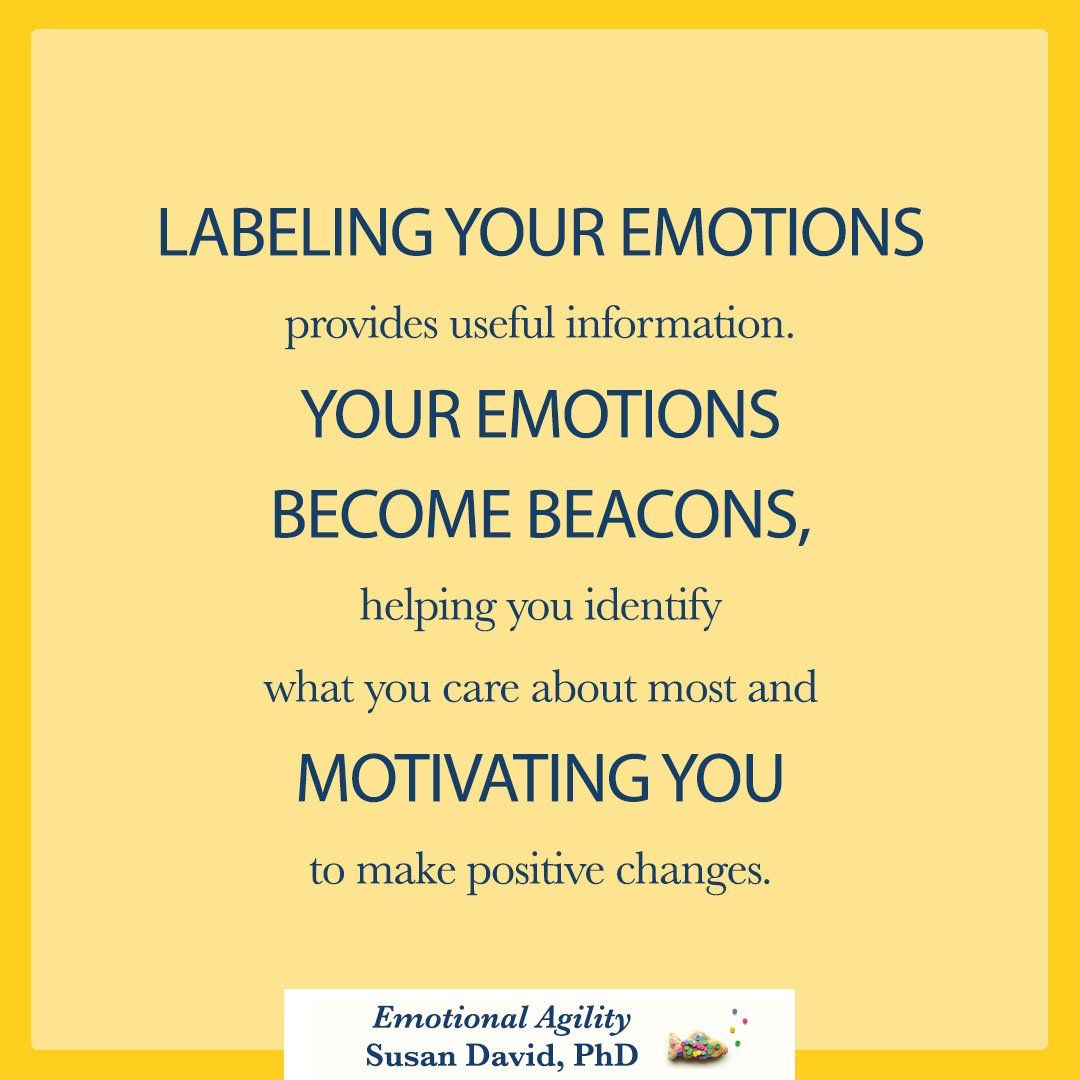
When we identify with a feeling, be it shame, frustration, sadness or anger, we can allow ourselves to become mired down in that feeling. David encourages us to consider our feelings, our emotions, as data to be used to remind us of what our values are and as a way to propel us forward. She encourages us to refrain from saying to ourselves something like “I am frustrated that I cannot lose these last 10 pounds” and instead say, “I notice that I am feeling frustrated about this. This tells me that I value health and fitness and these are the steps I can take to achieve the goal of fitness.”

Yes, it sounds a bit corny. Yes, it takes practice to retrain our brains to think more deeply about what our emotions are telling us. Yes, it requires us to be patient and understanding with ourselves. But, it will be worth it because it matters how we speak to ourselves.

If we can give ourselves permission to slow down and really think about what our emotions are telling us and to stop identifying with a feeling, we can use that information to make changes in our lives that could well mean the difference between living in depression and despair and living in hope and happiness. Happiness to some extent is a choice and we can choose happiness by retraining our brains to speak kindly to ourselves. Constantly engaging in negative self-talk and self-shaming is not the way to achieve happiness. Speaking kindly to ourselves and offering ourselves positive self-affirmations is a way to move toward happiness. Being gentle with and compassionate toward ourselves can move us closer to happiness.

Our brains are about 70 percent more likely to engage in negative thinking than positive thinking so retraining our brains takes practice. Moving from negative self-talk to positive self-talk takes persistence. Moving from depression and despair to hope and happiness requires daily effort and daily commitment. This may seem daunting at first, but the end result will be feeling better about yourself.

If this seems challenging, I encourage you to use a wet/dry marker to write on your bathroom or bedroom mirror a positive statement about yourself, such as “You are beautiful,” and practice saying that aloud to yourself every morning when you are dressing and at bedtime when you are winding up your day. Try doing this for a few weeks and try to notice if you start feeling better about yourself. Then, stick with it. Try a new positive self-affirmation. Be your own cheerleader.

What positive self-affirmation can you offer yourself to start? What nice thing can you say to yourself to start moving from depression and despair to hope and happiness? Notice what you might be feeling and use that data to propel you forward.

Karri Christiansen, MSW, LSW, CADC, CCTP

Emotions are data, not identity

Give yourself permission to slow down and choose how you want to respond

Life goes so fast. It seems more and more that we constantly are being bombarded by notifications, dings, pings and demands for our attention. Technology has in so many ways improved our lives and in so many other ways has become a nuisance for many people. There are so many demands for our attention. We may find ourselves overwhelmed and unsure of how to react.

This can be true for some people with regard to everyday demands at work, at home and in our social lives. It may seem as though we are forced to respond to every notification, every request, every invitation, every discussion, every argument immediately. It may seem as though everything has to be done right this second. What if that were not true? What would happen if you were to give yourself permission to slow down and really think about how you want to respond to any given thing? What would happen if before you were to respond, you checked in with your emotions and feelings and the chose how to respond to whatever demand for your attention has arisen?

When we give ourselves permission to pause, think about what we are feeling and why, we give ourselves permission to respond with thoughtfulness and consideration. When we give ourselves permission to slow down and really consider our emotions, we can use those emotions as data to help us determine our next move. It takes practice, but it might be well to remember that not everything requires an immediate response. Some of the best responses to demands for our attention are those that are slow and deliberate.

Every day, we are given the opportunity to really think about which of the demands for our attention really are worthy of our responses. Some things may require a little more thought and that is okay. It may feel as though we must immediately respond to every text, every notification we receive with immediacy, but that is not always the case. Some things can wait. Yes, there may be emergencies that require a quick response, but not everything in our lives likely rises to the level of emergency. It is okay to think about how want to respond to many of the things in our lives that demand our attention.

Some people may find it challenging to slow down, pause to consider feelings and emotions and then respond to something with thoughtfulness because they are fearful of how they will be perceived if they do not respond quickly. It is well to remember that it matters less what others think of us than it does to respond appropriately and with care. I understand this can be challenging for some, and that is okay. The more we practice being thoughtful and deliberate with our responses to life’s demands, the easier it becomes.

Can you give yourself permission to slow down, pause to consider your feelings and then choose how you want to respond to life’s demands? Can you give yourself permission to remember that not everything requires an immediate response? Life goes so fast. It is okay to give yourself permission to take things one at a time.

Karri Christiansen, MSW, LSW, CADC, CCTP

Give yourself permission to slow down and choose how you want to respond

Empathy requires compassion more than sympathy

Recently, I have found myself deeply affected by the frequent use of inappropriate emojis on social media. I find myself heartbroken to see people responding to others’ misfortunes, health concerns or other tragedies with the laughing emoji. This has made me wonder what would happen if more people offered others some measure of compassion and empathy.

There has been much talk lately of compassion and empathy and of how we can practice these in our daily lives. Compassion and empathy are different from sympathy. According to Merriam-Webster, sympathy means “feelings of pity and sorrow for someone else’s misfortune” while empathy means “the ability to understand and share the feelings of another.” Compassion means “sympathetic pity and concern for the sufferings or misfortunes of others.” Compassion can be a tool of empathy.

My social work hero, Brene Brown, sums up the difference between sympathy and empathy well in this brief video …

Compassion doesn’t sound like, “Oh, I can relate to that” nor does it start with “At least … .” Nor does it sound like, “I know exactly how you feel.” Actually, no you do not know exactly how someone else feels as their feelings likely are different than yours even if what you endured was similar. Compassion sounds like, “I hear you. I believe you. How can I best support you in this?” It’s easier to practice compassion for others when we start practicing compassion with ourselves.

Compassion for others requires us to truly consider not just what someone else is going through but how they are experiencing it. While two different people may experience something similar, that does not mean that person A’s feelings are exactly what person B is feeling. The best way to find out what each is feeling is to have a conversation about those feelings. Better yet, ask that person what he/she/they might want in terms of support.

Compassion for others really is much easier to practice if we first offer compassion to ourselves. That means speaking kindly to yourself, being gentle with yourself and acknowledging that you are doing the best you can with what you have right now. Compassion for self breeds compassion for others. Maybe that means cutting yourself a break when faced with challenges or daunting tasks. Maybe that means telling that critical inner voice to take a back seat and listening to your inner cheerleader.

What steps might you be able to take to start practicing compassion for yourself so that you may be better able to offer that same compassion to others? Can you take a few moments to pause in whatever it is you are feeling to speak kindly to yourself? Can you take some time to really consider what it is you are feeling in any given moment? It takes practice to give yourself permission to pause and really think about your feelings, to get in touch with your true feelings but doing so offers an opportunity to practice self-compassion.

Life goes by so fast and our days are often stacked with challenge after challenge. It is okay to slow things down and let yourself feel whatever it is you are feeling, be it happy, mad, sad, glad or other. Notice what you are feeling and be compassionate with yourself, particularly if those feelings are hard or uncomfortable. Consider the idea that your feelings are data, giving you information about how to handle what it is happening. Consider the idea that feelings are like visitors, they come and go and rarely stay forever. Consider the idea that whatever you are feeling, you can always offer yourself compassion, much as you might want others to do so for you.

In a world that seems ever nastier, ever more heartless, what steps might you be able to take to turn that around? Can you practice offering others your compassion by starting to do so with yourself? Can you take the time to consider what others might be feeling? Can you ask people what they might be needing in terms of support? Can you be a bright spot in someone else’s world?

Karri Christiansen, MSW, LSW, CADC, CCTP

Empathy requires compassion more than sympathy

How will you assert your independence?

Tomorrow marks Independence Day in the United States and while it may not feel like it for many people considering recent rulings by the Supreme Court, there still is much we can do to celebrate our remaining freedoms.

When we think about independence and freedom, different things come up for different people. Merriam-Webster defines independence as “the quality or state of being independent.” This can mean any number of things from personal independence to societal independence, political independence, religious independence and so on. I am more curious about what independence means for you.

I am working with several clients who seem to find it difficult to do things on their own, largely because of a fear of how they will be perceived by others. Some people find themselves feeling anxious going to the movies, for a cup of coffee or out to dinner by themselves because they are fearful that others will perceive them negatively. What if the opposite were true? What if instead people viewed you as strong, empowered and brave? What if instead people viewed you as courageous and independent?

How many of us hold ourselves back by believing we can’t do things on our own? How many of us find ourselves feeling pangs of regret because we convinced ourselves that we could not possibly do this, that or the other thing by ourselves? How many of us have repeatedly told ourselves that we cannot go here or there without someone else and then felt sad that we missed out on what could have been a beautiful adventure? What if the only thing holding you back from realizing how strong you are is you?

I understand that doing something on your own or going somewhere by yourself can sometimes be a bit frightening, but nothing ever grows in our comfort zones. If you want to be a strong, independent person you have to embrace risk, even if that means risking embarrassment, which is a temporary feeling. If you want to be a strong, independent person, you have to take steps to overcome your fear of what others may be thinking of you. Likely more than not, most people are not thinking of you in any negative way.

What steps might you be able to take to assert your own independence this 4th of July holiday? Could you take yourself to see some fireworks? Could you go to your community swimming pool by yourself? Could you go your town’s parade on your own? Could you take yourself out for ice cream? There is nothing wrong with enjoying the company of others. There is something to be said, though, for finding your courage and doing things on your own. I suspect that doing so will help you gain not just a sense of independence, but a sense of power.

Karri Christiansen, MSW, LSW, CADC, CCTP

How will you assert your independence?

You cannot shame yourself into self-love

I have been thinking about shame recently and how that has played a role not just in my life, but in the lives of clients and loved ones. As someone who still struggles with occasional self-shaming and as someone who hears and bears witness to others’ self-shaming, I know the destructive nature of this behavior and the profound effect it can have on people. I am reminded on a near daily basis that you cannot shame yourself into self-love.

It seems as though many people believe that beating ourselves up can improve performance or somehow enhance us, but such is not the case. There is a difference between showing tough love and beating ourselves up. Tough love can sound like inspiration or motivation. Beating ourselves up sounds like denigration and leads to feelings of unworthiness. This is self-shaming.

Self-shaming sounds like calling ourselves derogatory names. It sounds like yelling at ourselves for perceived mistakes or wrong doings. Self-shaming sounds like the opposite of self-compassion. Self-shaming rarely, if ever, leads to self-love.

When we think about shame, we often find ourselves feeling a certain way. Shame is that little voice inside us that says we are not good enough, pretty enough, handsome enough, smart enough, thin enough … enough of anything. Shame tells us we ARE not enough. It is different from guilt, which tells us we have done something bad. Shame can be the result of internalizing guilt to the point of making ourselves feel as though we are unworthy of the forgiveness of others and the forgiveness of ourselves. Shame leaves us feeling as though we are unworthy of love and belonging both from others and from ourselves.

When we shame ourselves for simply being human, we create for ourselves a broken record of self-defeating thoughts, which can lead to negative self-talk and behaviors which perpetuate those thoughts and that all leaves us feeling as though we are not good enough. So, how do we counteract all that? It starts with recognizing that we as humans are perfectly imperfect beings who sometimes learn by making mistakes and who are worthy of love and belonging simply because we exist. Countering self-shaming is dependent upon the way we talk to ourselves and by practicing self-compassion.

Self-compassion is a crucial component of self-love. It is challenging to offer others compassion if we cannot offer ourselves compassion. Self-compassion sounds like giving ourselves credit for doing the best we can with what we have right now. Self-compassion sounds like celebrating our accomplishments and victories, no matter how small or big. Self-compassion sounds like being kind and gentle with ourselves. Offering ourselves compassion is not selfish. It is necessary to move away from self-shaming.

When we think about self-love, many people seem to think that that is selfish, that somehow offering ourselves the same love we give freely to others somehow is to be frowned upon. This could not be further from the truth. In fact, the opposite is true. It can be challenging to freely love and accept others as the perfectly imperfect beings that they are if we cannot freely love and accept ourselves first.

It took me years to change the sound of my internal monologue, that one that beat myself up for even the smallest mistake or misdeed. But the more I practiced countering those self-shaming and self-defeating statements with self-compassion and loving statements, the better I started feeling not just about myself but about my entire life. What steps might you be able to take to counter your self-shaming statements? What would those statements sound like? I encourage you to notice and reflect on how you feel after even just a few days of practicing saying loving things to yourself. My suspicion is that you will notice feeling better about yourself and your life.

Brene Brown offers a great TEDTalk about shame and you can find it here: https://www.ted.com/talks/brene_brown_listening_to_shame.

~ Karri Christiansen, MSW, LSW, CADC, CCTP

You cannot shame yourself into self-love

Viewing failure as opportunity?

Many of us from time to time find ourselves feeling either as though we have failed at something, or worse, that we ARE failures. The word “failure” has only seven letters but really is a big, heavy word with pretty bad connotations.

Those who feel that they have failed at something be it at work or in their personal lives often can feel as if they have hit a road block. I wonder, though, what would happen if instead of looking at failure as a road block, they looked at failure as a speed bump that if they move slowly over it really does little damage? For many who feel like they ARE a failure, it seems as though the thought often is that failure is final. What if instead we considered failure as an opportunity to learn, grow and become? What if instead we looked at failure as part of success? What if instead of looking at failure as something from which we cannot recover as a launching point for something better?

How do we do that, though? It starts with recognizing that struggle, that failure sometimes is part of life. Most of us will struggle at some point in our lives. But that struggle does not mean that we are failing. That struggle means that we are growing.

Sometimes we feel like we are failing, as though we are failures, because our careers, our love lives, our relationships are not quite what we would want them to be. I wonder if that feeling could be a signal that perhaps it is time for change. Maybe we are unhappy with our careers because they have become unfulfilling or we feel there is no room for growth. Maybe that is a sign that now might be a good time to consider a career change. Changing careers does not mean you have failed at one thing, it means that you are meant for something different, something that better aligns with your hopes, dreams and aspirations.

Feeling as though our love lives are rife with failure perhaps means that we need to take stock of our relationships and look at any relationship patterns. Maybe it means that we need to reconsider both what it means to be a good partner and what kind of partner we deserve. Perhaps we can look at failure in our love lives as a signal that we deserve better and then demand better.

So many of us view failure as some sort of indication that we are somehow lesser than or unworthy of love or belonging. This could not be further from the truth. None of us is successful at every single thing we do. If we allow it, failure can be a teacher. What is failure teaching you? What can you learn about yourself from what you perceive as a failing? Failure does not have to be final. It only is final if you allow it to be so.

~ Karri Christiansen, MSW, LSW, CADC, CCTP

Viewing failure as opportunity?

When it all seems too much …

It seems as though the hits just keep on coming. We still are in the midst of the COVID-19 pandemic and now we learn of the spreading of monkeypox. The war in Ukraine rages on. We are seeing inflation skyrocketing. We are seeing women’s reproductive health rights being stripped away state by state and now face the same at the federal level. We see mass shootings on what seems to be a weekly basis with no action being taken regarding common-sense gun laws. All of this and the day-to-day stress we may be feeling from our jobs and relationships may leave us wondering what we can do to ease our pain.

With this week’s school shooting in Texas and the shooting in Buffalo, New York, just days ago, in addition to the assault on women’s rights, we may be wondering what we can do. We may feel helpless, hopeless, angry, incensed, sad, disappointed and betrayed by our country. We may not know what to do. Some people have said that they will be offering “thoughts and prayers.” For some this may seem an anemic response to the goings-on in the world. Perhaps now is a time to take action.

There are some things we can do to help us feel as though we are doing something, anything. We can write letters to our senators and congresspeople. We can participate in non-violent rallies. We can donate blood to help those who are victims of mass shootings. We can donate our time and/or money to causes that are important to us. We can elect leaders who are willing to protect our right to choose and who will work toward enacting sensible gun laws.

One of the most important things we can do when it all feels as though the world is imploding is to practice good self-care. It is okay to take a break from the news if it all seems too much. It is okay to remember that is good to stay abreast of the news while not getting bogged down if you find that your mental health is being affected by the day’s events. It is okay to surround yourself with people with whom you can share your thoughts and feelings and on whom you can rely for emotional support. It is okay to speak kindly to yourself and to offer yourself compassion for whatever it is you may be feeling. It is okay to remind yourself that whatever you are feeling is fair and valid.

We are living in troubling times. We may find ourselves at a loss as to how to manage. Should you feel the urge to take action, please remember to do so in a way that is respectful of others. And please remember that self-care is of the utmost importance when you find yourself struggling. If you find yourself feeling overwhelmed, remember that is okay to reach out to a mental health professional. It takes more courage to ask for help than it does to suffer in silence.

When it all seems too much …

How do you manage stress?

We are living in stressful times. We still are in the midst of the COVID-19 pandemic. An unjust war rages in the Ukraine. We’re hearing news of monkeypox spreading across the globe. Inflation is a concern for many. Gas prices are on the rise. Food costs are going up. Women’s reproductive healthcare is being attacked. All of these things, in addition to our everyday stressors of work and family life, can mean we are feeling an increase in stress.

I have heard people talking recently about how to avoid stress and find myself thinking that stress is largely unavoidable. Many of us encounter some measure of stress on a near daily basis. The question is, what can you do to manage stress? Stress is different than anxiety. Stress is most often caused by an external trigger such as a work deadline, the goings-on in the world, financial concerns or relationship troubles. Anxiety involves internal triggers that include some measure of trepidation or worry. Both stress and anxiety can result in physical sensations, such as trouble falling asleep or staying asleep, changes in appetite, difficulty concentrating, trouble focusing, muscle soreness or tension and irritability.

Both stress and anxiety can be managed by practicing healthy coping skills. Stress, to some extent, can be controlled by how we choose to react to it. We as humans have the power to choose how we are going to react to any given situation.

We can choose to look at stress as something that can be managed or we can choose to look at stress as an insurmountable obstacle. How we choose to respond to stress ultimately can affect not just our physical health but our mental health, as well.

What are some ways to manage stress? Practicing healthy coping skills such as exercise, meditation, listening to music, reading, watching a movie or television show all can help manage stress. Talk it out with a trusted other. Turning to alcohol, marijuana or other substances ultimately likely will cause more harm in the long run as doing so often runs counter to our values, leading to more stress and anxiety. Should you find that your stress turns to anxiety and becomes overwhelming, it might be time to turn to a mental health professional. Doing so does not mean that you are weak or somehow inept. It takes more courage to ask for help than it does to suffer in silence.

Here are some other ways to manage stress:

  • Talk to someone you trust.
  • Set boundaries and say “no”
  • Write a note to someone you care about.
  • Be assertive.
  • Use humor.
  • Spend time with friends and/or family.
  • Serve someone in need.
  • Care for or play with a pet.

Remember, you can choose how you respond to stress by pausing in the moment and noticing what you are feeling. It is perfectly acceptable to take a minute to decide how you want to respond to any given situation that you notice is leaving you feeling stressed. What do you need in that moment to manage your stress? Do you need to go for a walk around the block? Do you need to go listen to your favorite song for a few minutes? Do you need to go for a run? Whatever you need to do so manage stress in a healthy way is okay.

How are you choosing to respond to the stressors in your life? Can you give yourself permission to step back for a moment and decide what your next steps are? Can you take steps now to manage stress in your life so that it does not become anxiety? What can you do today to manage your stress?

How do you manage stress?

Are you practicing counter-empathy?

I recently read Brene Brown’s “Atlas of the Heart” and find myself continuing to think about one of the 87 emotions she speaks of in the book: schadenfreude, or taking pleasure in another person’s suffering or misfortune.

I have been thinking about this a lot in the days since I read the book, in part because I see so much of it on social media. And while this begs the question of why I am spending so much time on social media, it also begs a larger question, and that is what is happening in society today that so many people seem to engage in schadenfreude. There are many reasons but one of them is that it is easy to hide behind the cloak of relative anonymity of social media and use the laughing emoji to engage in taking pleasure in others’ suffering. I see it when people use that emoji to react to stories about COVID-19 related deaths or waves of the virus sweeping through communities, leaving scores sick.

It may seem as though engaging in schadenfreude can bring about some kind of connection, but that connection is more likely is counterfeit and will be short-lived. True connection is forged by giving ourselves permission to be vulnerable and to let others really see and understand us, it is forged by practicing compassion and empathy. Collective schadenfreude promotes what Brown calls in her book counter-empathy and means that our emotional reaction is incongruent with another person’s emotional experience.

According to Brown, schadenfreude actually shuts down the area of our brains that we use for empathy and lights up areas of the brain that make us feel good and entice us to engage in similar behaviors in the future. But practicing schadenfreude, while enticing at first, can often lead to deeper feelings of shame and guilt because doing so can mean that we have violated our values and what we really hold important.

Is practicing schadenfreude something we really want to do? Is feeling pleasure at the expense of another person’s troubles really who we want to be as a society? What does this say about how we can change so that we can be a more compassionate people?

The opposite of schadenfreude is freudenfreude and that is the enjoyment of another person’s success. It is a subset of empathy. What would happen if instead of taking pleasure in another person’s pain, we celebrated another person’s victories? Celebrating another person’s victories and asking what that victory felt like can create real connection. We forge connection by building people up, not by tearing people down.

Are you practicing counter-empathy?

Are you moving closer to or away from your values?

I recently read Susan David’s “Emotional Agility: Get Unstuck, Embrace Change, and Thrive in Work and Life” and found myself thunderstruck by what she says about how our emotions can lead us closer to or away from our values and it really got me thinking. How can we lean into our emotions in such a way as to move us closer to our values?

This begs an even bigger question and that is, “What are our core values?” Some of us know exactly what our core values are while others of us may struggle to name even a few core values. Even more ponderous is that idea that some of us struggle to name our emotions and thus have trouble discerning whether our emotions are moving us closer to or away from our values. Many of us know the primary emotions of happy, sad, mad. But there are many more beneath those, including excited, disappointed and afraid. How can we use our emotions to move us closer to our values?

One way to do so is to really drill down in any given moment and tap into what we’re really feeling. Sometimes when we’re feeling angry, there can be something underneath that anger, something like fear, sadness, disappointment or hurt. How might any of these emotions be moving you closer to or away from your values? Perhaps you value family and perhaps a family member has said or done something that initially left you feeling anger. What is beneath that anger and how can you tap into your emotion to move closer to your value of family? Perhaps that might require you to have what could be an uncomfortable conversation with that family member. Discomfort often does not mean danger, though sometimes can if there is a bear, wolf or lion in the room. Sometimes we have to do what is uncomfortable to move us closer to our values.

Sometimes we may find ourselves dealing with a certain emotion and that keeps us moving away from our values. Perhaps one of your values is health and fitness but you also struggle with addiction to club drugs and that leaves you feeling shame. How is this feeling of shame keeping you away from your value of health and fitness? Perhaps there may be some level of self-sabotage involved and so you not only stay stuck in addiction and also find yourself moving away from your value of health and fitness. What might you be able to do to move closer to that value? Might that mean cutting back or giving up club drugs? Perhaps that means seeking treatment for addiction so that you can move closer to that value.

Our emotions can be powerful tools for change if we give ourselves permission to tap into them, listen to them and use them to move closer to our values. This requires us to really pause and be present in the moment so that we can really discern what exactly it is that we’re feeling. This takes patience and practice, and courage. But as David says, “Courage is fear walking.” Doing the scary thing so can help us move closer to our values so that we can feel as though we are living true to ourselves and as authentically as we possibly can.

What steps might you be willing to take to use your emotions to move closer to your values? Can you first identify what your core values are? Can you give yourself permission to tap into your emotions? The more we live true to our values, the better we likely will feel about ourselves and our lives.

Are you moving closer to or away from your values?