
What is your anxiety telling you?

From time to time, most people notice feeling anxious. In the United States alone, some 40 million people live with anxiety at any given time. Many people, though, often do not quite understand that their anxiety is trying to tell them.

How do we know when we’re feeling anxious? We may notice that our heart seems to be beating faster, that we feel nauseous or faint or lightheaded. We may notice that we start to perspire. We may notice that we are feeling out of control.

Anxiety can stem from many things, including work, family, friends, driving, flying or the possibility of health concerns. Anxiety tells us that there is something to be feared, or that we are in a dangerous situation. More often than not, though, what we are facing is less dangerous than it is uncomfortable. It might behoove you to remember that discomfort does not necessarily mean danger. Anxiety tries to convince us that that presentation we have to give is dangerous or that that mammogram we have to have will tell us we have cancer or that our plane will crash on the way to Italy. Are these things possible? Perhaps. Are these things likely? Perhaps not.

The thing about anxiety is that it tells us that if we worry enough about these things, we can somehow control the outcome. Anxiety tells us that we can somehow control the future or what other people think, say or do. Anxiety tells us that if we do this, that or the other thing, we can assert some control over what happens next. The fact of the matter is, though, that we have little to no control over the future or other people, in large part because people are often unpredictable.
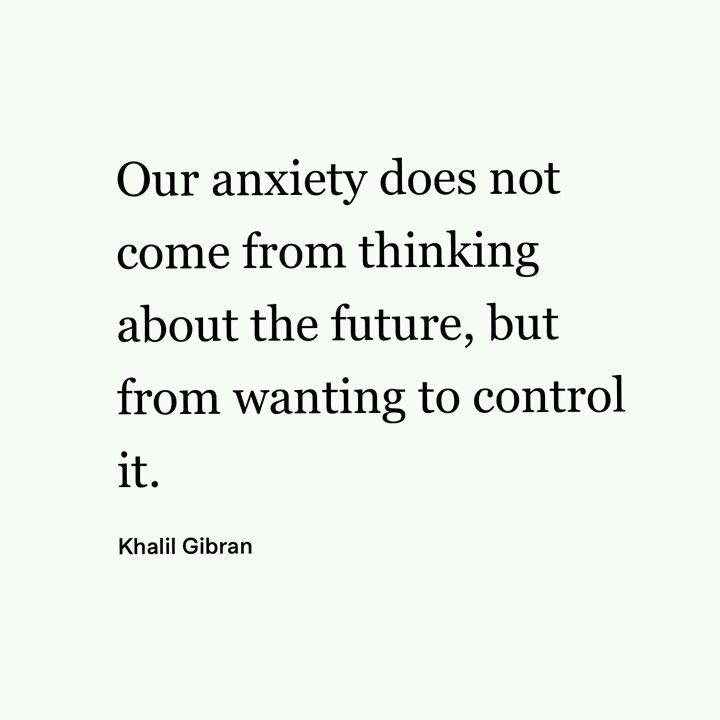
When we try to control the future by performing certain behaviors or acts, what we are trying to do is rid ourselves of the worry about the future. If instead we try to remember what we really do have control over—what we think, say or do—we may start to feel a bit less anxious.

How do we manage symptoms of anxiety or approach situations with less anxiety. One of the ways to manage those pesky symptoms of anxiety is to remember to breathe. Oftentimes, when we feel anxious we may notice that we are holding our breath or breathing shallowly. If we give ourselves permission to slow down, take a few deep breaths that are longer on the exhale than the inhale, we can slow down our central nervous system and get out of fight or flight mode and start to feel less anxious. We also can remind ourselves to really look at the situation before us. Is it really dangerous or is it uncomfortable? This may require us to pause for a few moments and really get in touch with that feeling of anxiety, and that is okay.

Another way to manage symptoms of anxiety is to create some space and distance between us and that feeling of anxiety. If we say to ourselves, “Oh, I’m so anxious!” what likely will happen is that we will start to feel more anxious because we are identifying with that feeling of anxiety. If instead we say, “Oh, I notice that I am feeling anxious,” we create some distance between us and that feeling of anxiety. We start to feel less anxious.

Anxiety is like other feelings, and what feelings do is provide us with information about certain situations. It may do well to listen to your body and tend to your body’s needs. Is your anxiety leaving you feeling nauseous? Lightheaded? As though your heart is beating faster? These symptoms may be telling you that you need to take a breath. If we listen to our bodies, they will tell us what we need.

Millions of people on this planet live with anxiety. Most of us will feel anxious from time to time. That is normal. Anxiety provides information about the situation we are facing. That feeling of anxiety, like all feelings, provides data, information. If we can give ourselves permission to slow down, breathe, and really assess the situation, we may find that what we are facing really is more uncomfortable than it is dangerous. We may also realize that while we can control what we think, say or do, we largely haven’t much control over other people, the future, or certain outcomes.

What steps can you take to address your anxiety? Would it help to practice deep breathing? Do you need to speak to a trusted other or mental health professional? Do you need to pause and think about what you really do have control over? Do you need to remind yourself that anxiety is just a feeling that likely will pass? You have the power to manage your symptoms of anxiety.

~ Karri Christiansen, MSW, LSW, CADC, CCTP
What is your anxiety telling you?

Is it time to HALT the BS?

We are just two days into the new year and already I am hearing from people who are feeling stressed to the point of burnout, and as though the holiday season has left them feeling more tired than relaxed. I also am hearing from people sharing that their feelings of stress and anxiety and burnout and exhaustion have meant an increase in engaging in addictive behaviors as a way to somehow cope.

Those behaviors may have served a purpose at some point, but many people are finding that those same behaviors (such as consuming alcohol, marijuana or other substances, gambling, shopping or watching pornography) no longer are helping as much as they used to, or even at all. In many case, these behaviors are making things worse at home, work and school, with our family, friends and loved ones.

So why do we turn to such behaviors when, at best, they only work temporarily? Well, we do so because they once seemed to work for a while and we hope that they still will. Problem is just that: they only work temporarily and then we’re back to Square One.

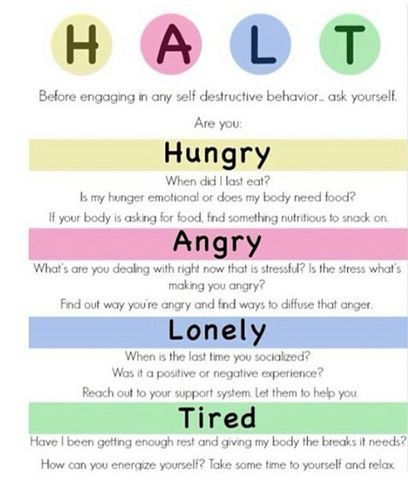
We often turn to our addictive behaviors when we are feeling hungry, angry, lonely or tired. In fact, many Twelve Step programs remind us of the acronym HALT to give us pause when we are thinking about engaging in one or more of our addictive behaviors. If we can give ourselves permission to think about what we really are feeling and what we really are needing, we sometimes can avoid engaging in the self-destructive behaviors of any type of addiction.

For many people, reminding themselves of the HALT acronym can be helpful. Sometimes, though, there is more than just hungry, angry, lonely or tired going on. Sometimes, there’s also boredom or stress. If we try to remember to HALT the BS, we may be even more successful at taming our self-destructive behaviors.

Some people find that when they’re bored, they also engage in self-destructive behaviors because they feel as though they have nothing else to do. What could happen instead of engaging in self-destructive behavior is reaching out to someone, playing a game with friends either online or in real life, baking, knitting or going for a walk or run.

Often, when people are feeling stressed, they turn to those things that somehow bring them some measure of comfort. That could be using alcohol or other substances, binge eating, shopping, watching pornography, or gambling. But it could mean engaging in exercise, meditation or calling a friend or family member, or watching a movie or reading a good book.

We can remind ourselves that while our self-destructive behaviors may once have served a purpose in our lives when we have felt hungry, angry, lonely, tired, bored or stressed, those behaviors ultimately usually leave us feeling worse, setting ourselves up for self-shaming and negative self-talk (which perpetuates the cycle of using). If we can give ourselves permission to think about what we really are feeling and what we really need, we can avoid engaging in behaviors that likely more than not will leave us feeling worse.

Is it time for you to HALT the BS? What are you really feeling? What do you really need? Is it time to reach out to someone? To eat healthy food? Is it time to think about why you are feeling angry and what a healthy response to that anger would be? Do you need some good sleep? Are you bored? Are you stressed? What healthy coping skills might you turn to to HALT the BS?

~ Karri Christiansen, MSW, LSW, CADC, CCTP

Is it time to HALT the BS?

Anxiously awaiting

Anxiety. We all feel it from time to time. But for some people, anxiety can become overwhelming to the point that if affects our daily functioning. Some people experience anxiety to the point of debilitating panic attacks, usually because of some internal or external trigger.

For some people, the fear of the panic attack alone can leave us paralyzed to the point where we cannot go to work or school, we cannot drive, we cannot leave the house. For some people, the fear of impending doom that comes with a panic attack can leave one feeling that she is going to go crazy or lose control, pass out or even die from cardiac arrest. Panic attacks can leave us feeling embarrassed and as if we are failures for not being able to control our feelings.

But what if, instead of fighting the panic attack, we leaned into it? What if we welcomed the panic attack? What if instead of fighting the feelings of anxiety, we acknowledged them, owned them? What if we took just a moment to try to determine what triggered those feelings? It is more likely that not that if we accept the feelings of anxiety and the panic attack, it will dissipate more quickly than if we fight those feelings.

So often, those who live with debilitating anxiety feel as though they are weak or a failure for experiencing a panic attack. But we are only human, and we are entitled to our feelings. Anxiety is just a feeling, at times crippling, yes, but still just a feeling. Think for a moment about your coping skills. What do you usually do to calm yourself? What have you done in the past to survive the panic attack? Whatever it is, do that again. Give yourself permission to take care of yourself when you are inside the panic attack. What can you do to make yourself feel better? What are your coping skills?

So many of us forget when we are in the midst of panic that we have survived this feeling before. Indeed, our rate of surviving a panic attack likely is 100 percent. The likelihood that the panic attack will in fact lead to cardiac arrest is slight.

It is important to understand that your feelings of anxiety and panic are valid. Something internal or external triggered those feelings. Can you take a moment to examine what is happening around you to trigger those feelings? If you can, I guarantee you that you can quiet those feelings. It is at that moment when you have determined the cause of your feelings that you can begin to employ your coping skills, be it listening to music, repeating a helpful mantra in your head, going for a walk if your neighborhood is safe, running or working out or watching a movie.

Often when we are inside the feelings, we forget our breathing. In the midst of a panic attack, we tend to feed it by breathing faster and faster, which in turn increases our heart rate and the feelings that we are going to have a heart attack. Instead, perhaps try to practice deep breathing, taking long slow breathes in through your nose and out through your mouth. I like to do so while repeating to myself “easy” on the inhale and “calm” on the exhale. It soothes me.

Feelings of anxiety are in fact just that: feelings. We can choose to feel differently about any given situation. We can choose how we react to a trigger. For instance, instead of working yourself into a frenzy by expecting the worst about an activity or situation, think to yourself, “What is the worst that can happen?” Likely, whatever it is will not kill you. It may well make you feel uncomfortable, but the chances that you are going to die are slim. What is the worst that can happen? Prepare yourself for that and you can embrace what comes your way instead of fighting it.

We make thousands of decisions every day. Indeed, life is a series of choices. You choose how you are going to react to any given situation. You can choose to embrace the fact that some things will make you feel anxious. And sometimes, that is a good thing. To some extent, anxiety protects us from harmful situations. But you can choose to feed that anxiety but what-iffing it to death or you can accept the situation as it is, embrace the fact that you feel anxious and work through those feelings. It only takes a few moments to determine what it is exactly about any given situation that leaves you feeling anxious to choose what to do with that anxiety. Fight it and likely suffer a panic attack or embrace your feelings, deal with them and move on.

It sounds easy, yes? For some people it is, for others more help is needed. This is where medications come in. There is nothing wrong with accepting the fact that medication may be needed to temper the feelings of anxiety and panic. But before taking any medication it is imperative that you talk with your doctor or psychiatrist about what you have been feeling, how you have tried to manage those feelings and how medication may or may not help you. Taking medication for anxiety and panic does not mean that you are weak or that you are a failure. It simply means that you need a little bit more help. And it takes more courage to seek help than it does to suffer in silence.

You can choose to lean into the anxiety or you can choose to fight it. Accept your feelings and move on or dwell in them and feel miserable. Life is a series of choices. You can start to make better choices or you can continue to practice the same behaviors you have been practicing and stay comfortably uncomfortable. Your life and how you experience it is entirely up to you.

Anxiously awaiting