
Can we enjoy being wrong?

It seems as though we are living in an era when many people have concerns about being wrong, and what being wrong says about them. We currently live in a time when we are flooded with misinformation and disinformation, with many people doubling-down on their beliefs even in the face of new or updated information, or information that runs contrary to their strongly-held beliefs. We are living in an era when people seemingly cannot accept even the idea that they may be wrong.

What would it mean if we were to entertain the notion that we could, in fact, be wrong? It seems as though many people believe that being wrong carries some heavy meaning about them as human beings. What if that weren’t true? What if being wrong could be joyful, pleasurable?

In the book “Think Again,” Adam Grant encourages us to consider not just that we could be wrong in our thinking, but the idea that being wrong opens us up to the possibility of learning something new. What if instead of carrying the belief that being wrong means we somehow are defective as a human being, we consider the notion that we could be wrong about all sorts of things and that means we could be open to learning something new.

What if being wrong doesn’t say something about you as a human being other than the fact that you are open to learning? Could you take pleasure in the idea of learning something new? Can you entertain the notion that you can both learn something new and still hold onto your beliefs?
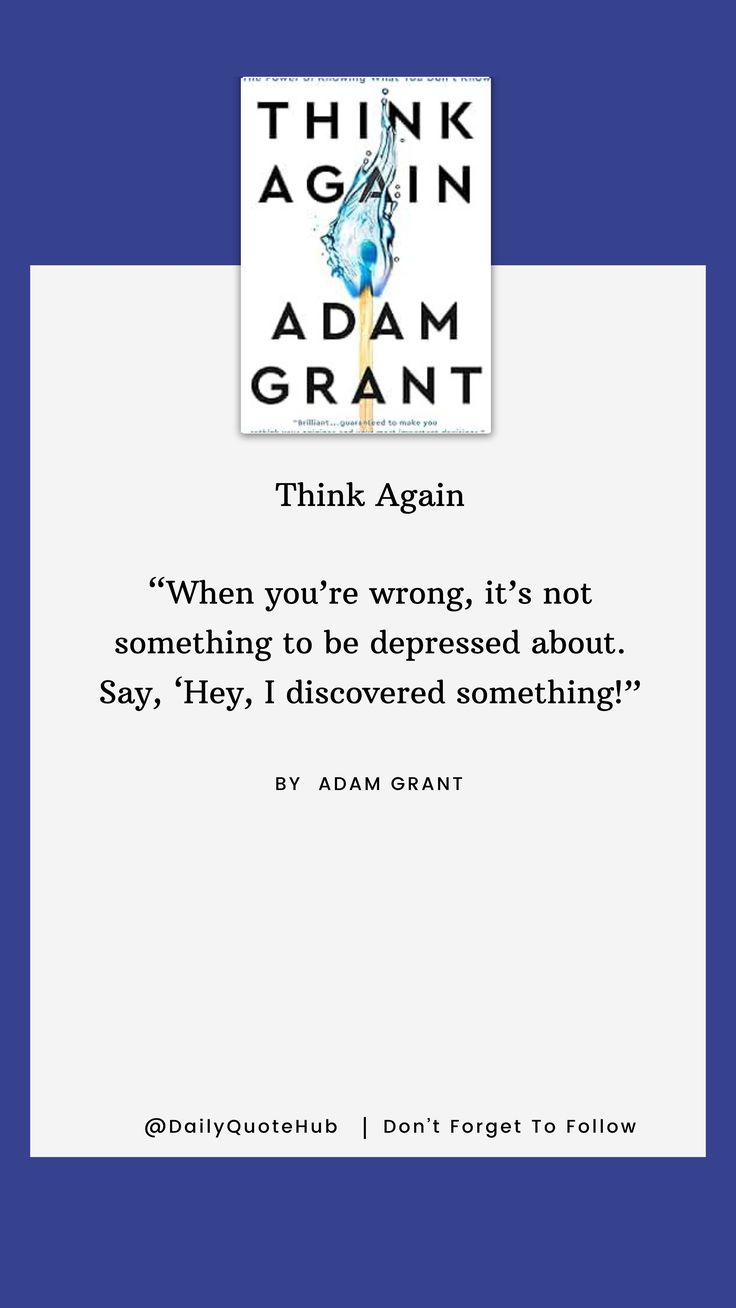
We can hold both the idea of being wrong AND stay true to our beliefs while entertaining the idea that others may have new or updated information. That does not have to say anything about who we are as humans, other than that we may have just discovered some new piece of information, as well as something about ourselves.

Being wrong is not a character flaw. Being wrong does not have to mean that we have to upend our way of thinking. It just means that we can be open to new ideas or new information. When we double-down on what we already think we know, we do not leave any room for learning. When we double-down on what we think we already know, we lose an opportunity to change and grow as people, as thinkers. It seems there is a lot of that happening now, in the age of misinformation, disinformation and living in the echo chamber of social media.

How do we open ourselves up to the possibility that we could be wrong? We enter into conversations with people who may think differently than we do and approach them with curiosity and compassion. We entertain the notion that we may not be the smartest person in the conversation or in the room. And we admit to ourselves that if we think we are the smartest person in the conversation or in the room, we likely are in the wrong room.

Life should be about learning. Learning is how we grow, change and evolve. When we open ourselves up to the idea of learning, we give ourselves permission to check our facts, vet our news sources and engage in compassionate conversation with people who think differently than we might.

Can you give yourself permission to consider that you may be wrong … from time to time? Can you give yourself permission to be open to new ways of thinking? Can you think like a scientist by checking your facts, vetting your sources, and verify that you have not been fed misinformation or have fallen prey to disinformation? Being wrong is not a character flaw. Give yourself permission to be a lifelong learner.

~ Karri Christiansen, MSW, LSW, CADC, CCTP
Can we enjoy being wrong?

Is it time to HALT the BS?

We are just two days into the new year and already I am hearing from people who are feeling stressed to the point of burnout, and as though the holiday season has left them feeling more tired than relaxed. I also am hearing from people sharing that their feelings of stress and anxiety and burnout and exhaustion have meant an increase in engaging in addictive behaviors as a way to somehow cope.

Those behaviors may have served a purpose at some point, but many people are finding that those same behaviors (such as consuming alcohol, marijuana or other substances, gambling, shopping or watching pornography) no longer are helping as much as they used to, or even at all. In many case, these behaviors are making things worse at home, work and school, with our family, friends and loved ones.

So why do we turn to such behaviors when, at best, they only work temporarily? Well, we do so because they once seemed to work for a while and we hope that they still will. Problem is just that: they only work temporarily and then we’re back to Square One.

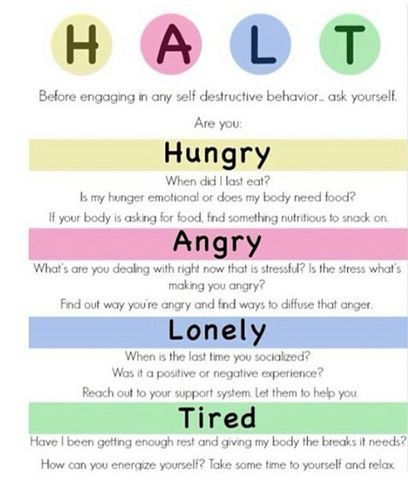
We often turn to our addictive behaviors when we are feeling hungry, angry, lonely or tired. In fact, many Twelve Step programs remind us of the acronym HALT to give us pause when we are thinking about engaging in one or more of our addictive behaviors. If we can give ourselves permission to think about what we really are feeling and what we really are needing, we sometimes can avoid engaging in the self-destructive behaviors of any type of addiction.

For many people, reminding themselves of the HALT acronym can be helpful. Sometimes, though, there is more than just hungry, angry, lonely or tired going on. Sometimes, there’s also boredom or stress. If we try to remember to HALT the BS, we may be even more successful at taming our self-destructive behaviors.

Some people find that when they’re bored, they also engage in self-destructive behaviors because they feel as though they have nothing else to do. What could happen instead of engaging in self-destructive behavior is reaching out to someone, playing a game with friends either online or in real life, baking, knitting or going for a walk or run.

Often, when people are feeling stressed, they turn to those things that somehow bring them some measure of comfort. That could be using alcohol or other substances, binge eating, shopping, watching pornography, or gambling. But it could mean engaging in exercise, meditation or calling a friend or family member, or watching a movie or reading a good book.

We can remind ourselves that while our self-destructive behaviors may once have served a purpose in our lives when we have felt hungry, angry, lonely, tired, bored or stressed, those behaviors ultimately usually leave us feeling worse, setting ourselves up for self-shaming and negative self-talk (which perpetuates the cycle of using). If we can give ourselves permission to think about what we really are feeling and what we really need, we can avoid engaging in behaviors that likely more than not will leave us feeling worse.

Is it time for you to HALT the BS? What are you really feeling? What do you really need? Is it time to reach out to someone? To eat healthy food? Is it time to think about why you are feeling angry and what a healthy response to that anger would be? Do you need some good sleep? Are you bored? Are you stressed? What healthy coping skills might you turn to to HALT the BS?

~ Karri Christiansen, MSW, LSW, CADC, CCTP

Is it time to HALT the BS?