Pity is not the same as compassion

So, like many other people, I am reading “The Let Them Theory” by Mel Robbins, and I find the book intriguing. Much of what I am reading really resonates with me, as likely is true for many other readers. But, while a lot of what I am reading seems on target, some of what I have read so far has rubbed me that wrong way as a human and as a social worker.

In the book, Robbins intimates that most people have the emotional maturity of an eight-year-old. I respectfully disagree. I think many people have better emotional maturity than that. Perhaps what some people are lacking is the emotional vocabulary to accurately describe what they are feeling. Emotions are nuanced, and having the vocabulary to accurately describe what we are feeling is important. That does not mean that if we do not have an expansive emotional vocabulary, we have the emotional maturity of an eight-year-old.

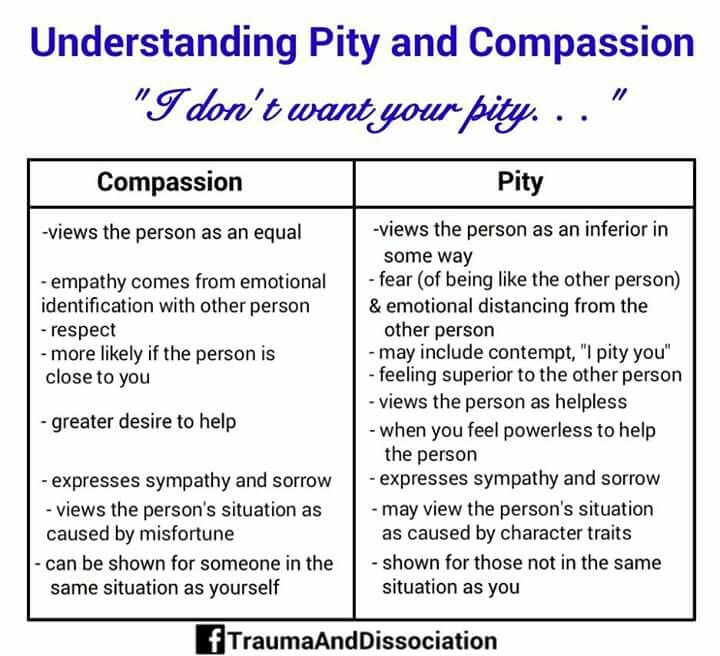
Robbins then goes on to say that we should offer those whose emotional maturity may be less than our own some pity. And compassion. Well, pity is not the same as compassion. In fact, pity and compassion are enemies. Pity implies a tone of superiority toward others while compassion views others as equals.

Perhaps what Robbins is trying to say is that when we choose to react to others whose emotional maturity is less than our own, what we should do is try to offer understanding for where they are coming from. Understanding goes a long way in an attempt to offer compassion. But again, pity is not the same as compassion. Offering someone pity can mean that we keep emotional distance from another person, while offering someone compassion offers us a chance to lean and really try to understand where another person is coming from.

Pity is more akin to feeling sorry for someone and not really trying to understand their plight. Compassion is trying to understand someone’s experience and honoring that experience. If we are trying to gain a better understanding of another person’s emotions or experience, offering that person compassion goes a lot farther than offering someone pity.

As I move through the book, I am reminded that using the “Let Them” theory is just a tool. Anyone who wants to be a better human, who wants to learn that they can choose how to react to what another person says or does may do well to remember that while we cannot control what others think, say or do, we can choose how we want to respond to others. Reminding ourselves that we all experience emotions differently, and express those emotions differently also may be helpful. And, reminding ourselves that some people may have developed a more expansive vocabulary to describe their emotions than have other people, that does not mean that their emotional maturity is less than or better than ours. It’s just different.

Compassion for others requires that we lean in and try to understand where another person is coming from. Compassion asks us to be curious about another person’s experience. It does not mean that we feel sorry for another person or compare that person’s experience to our own. Compassion means that we believe another person’s telling of their experience and respect their experience as their own. Compassion does not engage in comparison with another person’s experience. Compassion requires us to honor another person’s experience.

~ Karri Christiansen, MSW, LSW, CADC, CCTP

Pity is not the same as compassion

Do you want to fit in, or belong?

We are living in unprecedented times. For many people, the world seems, at best, topsy-turvy with wars raging, wildfires out of control thanks to climate change, people in government seemingly hell-bent on whittling away at human rights, and artificial intelligence apparently reducing some people’s need for in-real-life human-to-human contact. Some people, though, appear to be in search of something that connects them with other humans. The question is, are folks trying to fit in, or are people wanting to belong?

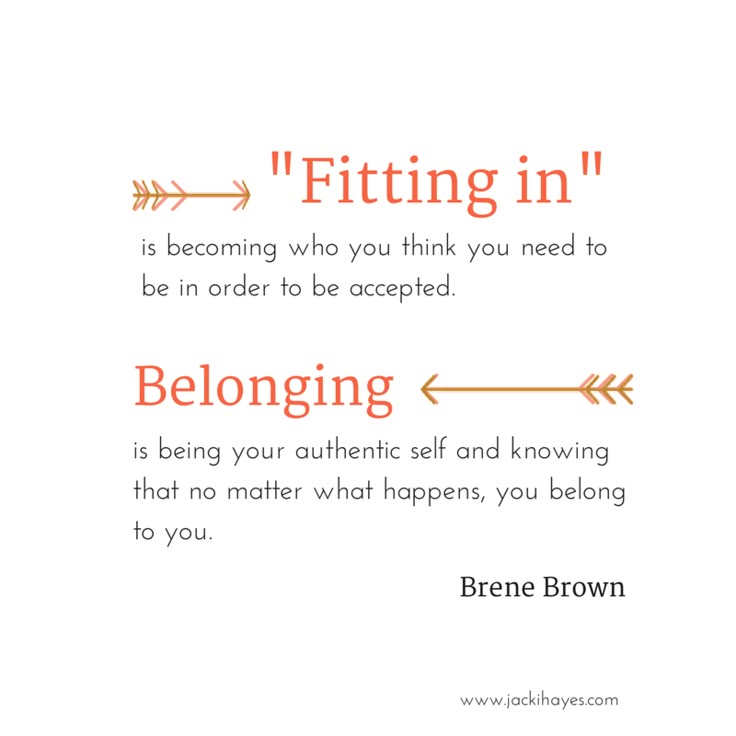
This all begs the question of, what is the difference between fitting in and real belonging? For one thing, real belonging requires equal measures of vulnerability and compassion, something many people shy away from or outright reject because both vulnerability and compassion can be downright scary. Fitting in is different. Fitting in usually offers less depth, yet somehow requires more effort and can cause more anxiety than true belonging. When we strive to fit in with a certain group of people, we can find ourselves working hard to become like the people we are trying to fit in with, often to our own detriment. That alone can be exhausting, particularly if the people we are trying to fit in with are different in their beliefs, values, interests or ideals.

When we are trying so hard to feel as though we fit in with a certain group, we may find that we are doing so because of appearances or because are concerned with how others view us or what they think of us. That is not healthy and can lead to anxiety. Sometimes we try to fit in—akin to fitting a square peg into a round hole—because not fitting in with a certain crowd or group would mean that we are alone and/or lonely. Sometimes we try to fit in with a certain crowd because even the thought of finding a new crowd is more daunting than working so hard to fit in. Unfortunately, the cost of staying with that group can actually leave us feeling more alone.

We forge real connection and belonging by giving ourselves permission to distance ourselves from those people with whom we really do not fit. That may mean taking a step back from certain groups, certain people within a group, or staying in touch with only certain people in a group. We forge real connection and belonging by giving ourselves permission to consider what it really is we are needing in relationships with other humans. We forge real connection and belonging by giving ourselves permission to really see others and to be really seen by others. That requires some measure of compassion and vulnerability, things many people are not all that comfortable with.

Finding your tribe may sound daunting, but does not have to be. Give yourself permission to really think about what your interests are, what your needs in relationships are, and to put yourself in a position to be with people in real life who lift you up rather than leave you feeling anxious about whether you fit in. This may take time, and that is okay. The time spent forging meaningful relationships that offer true belonging will be worth it—far more so than trying to fit in with those who are not really your people.

Now, perhaps more than ever, it is important to be engaged in relationships that fill you up rather than leave you feeling drained and exhausted. Now, perhaps more than ever, it is important to be engaged in relationships that offer deep, meaningful connection with people who offer you the opportunity to be your authentic self. You deserve that. What can you do to ensure that you are with your tribe, that you are reaping a feeling of belonging with other humans?

~ Karri Christiansen, MSW, LSW, CADC, CCTP

Do you want to fit in, or belong?

How will you celebrate your independence?

Today in the United States, many of us are celebrating the country’s independence. This makes me think about that word, “independence,” and what it means. Of course, it means many different things to many different people.

According to Merriam-Webster, the word independent means: not subject to control by others. In my world of mental health and substance use disorders, being independent could mean being free of undue influence of others, or being free of a substance or drug of choice. In either case, people could consider how they would like to celebrate their independence this 4th of July.

Some people may find it difficult to celebrate their independence today, particularly if they are in abusive or controlling relationships, or if they are struggling with substance use disorders. Others may find it difficult to celebrate their independence if they find they are living with mobility concerns. Still others may find that they are unable to celebrate their independence if they are facing housing issues, poverty or incarceration.

For others, though, today might be a good day to consider how you might assert your independence. That may mean considering what the word “independence” means to you. Could it mean giving yourself permission to set and enforce healthy boundaries, particularly in relationships that have become toxic? Could it mean summoning the strength to end a relationship that no longer serves you, is unhealthy, or brings you joy? Could it mean distancing yourself from people or places that leave you feeling trapped, insecure or used? Could it mean making the call to enter treatment for substance use?

Perhaps on this Independence Day, celebrating or advocating for your independence means you celebrate you and all the healthy ways you take care of yourself. Perhaps on this Independence Day, you engage in healthy self-care and put your needs, wants, hopes and desires at the forefront. Perhaps on this Independence Day, you celebrate all you are and all your potential and give yourself permission to take that next step you’ve been thinking about for so long in your career, family life, or relationships.

When we give ourselves permission to think about what that word “independence” means to us, we really can think about how we want to assert and celebrate our independence. Maybe that means setting ourselves free from the shackles of a controlling other or calling for help to escape an abusive relationship. Maybe that means setting a boundary in a toxic relationship, be that with a coworker, family member, or friend.

We have the right to claim our independence in a way that is respectful of others yet also ensures that our needs are met. We have the right to claim our independence in a way that leaves both ourselves and others with dignity. We have the right to claim our independence from those who leave us feeling oppressed, less than, or used.

Sometimes in life, we have to take care of our own needs. Sometimes in life, we have to advocate for ourselves. How can you claim your independence today? What would it mean for you to assert your independence today? Can you celebrate your independence today?

~ Karri Christiansen, MSW, LSW, CADC, CCTP

How will you celebrate your independence?