Pity is not the same as compassion

So, like many other people, I am reading “The Let Them Theory” by Mel Robbins, and I find the book intriguing. Much of what I am reading really resonates with me, as likely is true for many other readers. But, while a lot of what I am reading seems on target, some of what I have read so far has rubbed me that wrong way as a human and as a social worker.

In the book, Robbins intimates that most people have the emotional maturity of an eight-year-old. I respectfully disagree. I think many people have better emotional maturity than that. Perhaps what some people are lacking is the emotional vocabulary to accurately describe what they are feeling. Emotions are nuanced, and having the vocabulary to accurately describe what we are feeling is important. That does not mean that if we do not have an expansive emotional vocabulary, we have the emotional maturity of an eight-year-old.

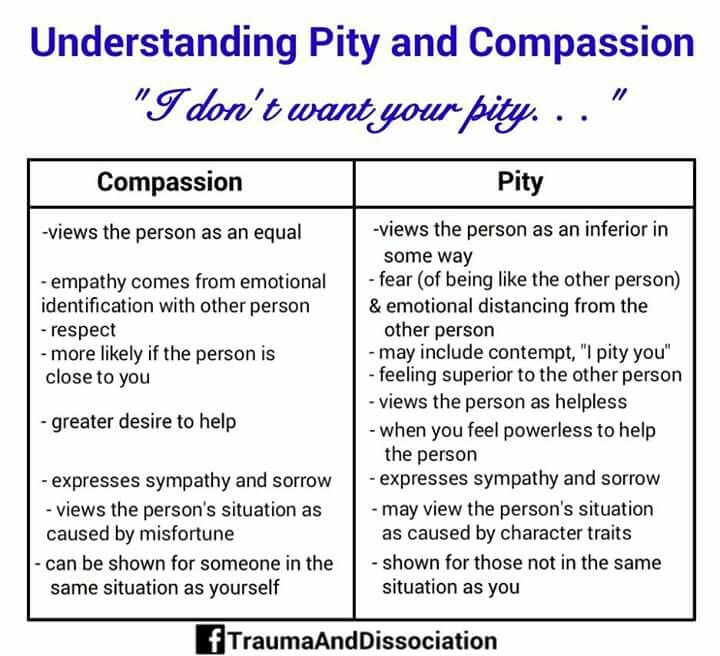
Robbins then goes on to say that we should offer those whose emotional maturity may be less than our own some pity. And compassion. Well, pity is not the same as compassion. In fact, pity and compassion are enemies. Pity implies a tone of superiority toward others while compassion views others as equals.

Perhaps what Robbins is trying to say is that when we choose to react to others whose emotional maturity is less than our own, what we should do is try to offer understanding for where they are coming from. Understanding goes a long way in an attempt to offer compassion. But again, pity is not the same as compassion. Offering someone pity can mean that we keep emotional distance from another person, while offering someone compassion offers us a chance to lean and really try to understand where another person is coming from.

Pity is more akin to feeling sorry for someone and not really trying to understand their plight. Compassion is trying to understand someone’s experience and honoring that experience. If we are trying to gain a better understanding of another person’s emotions or experience, offering that person compassion goes a lot farther than offering someone pity.

As I move through the book, I am reminded that using the “Let Them” theory is just a tool. Anyone who wants to be a better human, who wants to learn that they can choose how to react to what another person says or does may do well to remember that while we cannot control what others think, say or do, we can choose how we want to respond to others. Reminding ourselves that we all experience emotions differently, and express those emotions differently also may be helpful. And, reminding ourselves that some people may have developed a more expansive vocabulary to describe their emotions than have other people, that does not mean that their emotional maturity is less than or better than ours. It’s just different.

Compassion for others requires that we lean in and try to understand where another person is coming from. Compassion asks us to be curious about another person’s experience. It does not mean that we feel sorry for another person or compare that person’s experience to our own. Compassion means that we believe another person’s telling of their experience and respect their experience as their own. Compassion does not engage in comparison with another person’s experience. Compassion requires us to honor another person’s experience.

~ Karri Christiansen, MSW, LSW, CADC, CCTP

Pity is not the same as compassion

Is it time to spring clean your mind?

For many people, spring can be a season of renewal. Many people approach this new season with hopes of spring cleaning their homes, decluttering and making their spaces tidy and comfortable to live in. But, can this also be a time to spring clean your mind?

What could it look, sound and feel like to do a little spring cleaning of the mind?

For starters, it could look like replacing some of your negative self-talk with positive self-talk. This could take the form of thought stopping, or literally saying “stop” when we notice ourselves going down the rabbit hole of negative self-talk or self-shaming talk. This also could mean practicing positive self-affirmations, whether that is in our minds or out loud so our brains can hear. Remember that your brain is listening to everything you say to yourself, all day, every day, so it is important to speak kindly to yourself.

Spring cleaning the mind also could mean ridding ourselves of all the negativity that we encounter on social media. Maybe that means whittling down your friends list to include only those people with whom you have a real connection, or cutting out those folks who engage in negativity. For some, that may mean a social media detox of anything from a few days to a few weeks, to a few months or even forever. For some people, a social media detox can mean setting a time limit for consumption, be it just a few minutes to an hour. Taking a break from social media can help us reset and regroup, and really think about who and what is important to us.

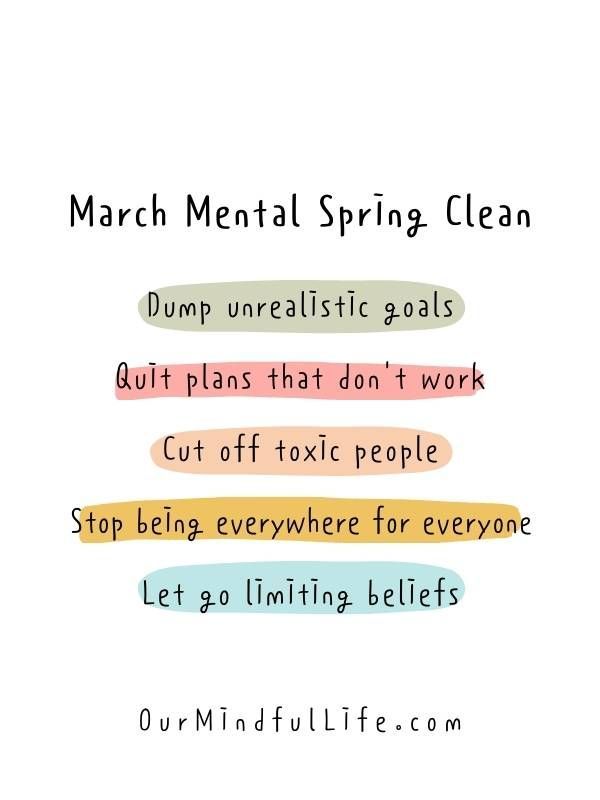
For some people, a spring cleaning of the mind can mean abandoning unrealistic or perfectionistic goals. Maybe this means rethinking what some of your goals are, really giving some thought to what is and what is not feasible given your current situation. Maybe that means giving some thought to what it is you really want to accomplish, and setting small goals along the way to that one big goal. This also can include some self-compassion, particularly if you found a goal to be impossible to reach at this stage in life.

A good mental spring cleaning also could mean letting go of the need to be everything and everywhere for people who either unwilling or unable to reciprocate. Maybe that means setting healthy boundaries with the people in your life. Maybe that means saying “no” to the things and people who no longer bring you joy. Setting boundaries is an act of self-love and is in no way selfish. Boundaries teach others how to respect us. This also could mean asking for help with caregiving, specific tasks or chores around the house or yard. Asking for help takes more courage than does suffering in silence.

Spring can be a time of renewal for many people. In addition to noticing flowers start to bloom, perhaps this can be a time to offer your mind a chance to bloom into healthy thoughts and actions. Letting go of unrealistic goals and expectations of and for yourself and others is a beautiful way to embrace the new season. Offering yourself a chance to really think about who and what is important in your life can make transitioning into this new season a time of real renewal. What might you be able to do to spring clean your mind?

~ Karri Christiansen, MSW, LSW, CADC, CCTP

Is it time to spring clean your mind?

You can’t self-care yourself out of burnout

For many people, it’s been a long year—and we still have a few weeks to go. For others, it’s been a rough start to the decade, having endured a global pandemic, what for many has been a challenging economy and now, a fraught election. We may be feeling stressed or anxious, or some combination thereof. Others, though, may be feeling something deeper, an exhaustion that just won’t go away. Many people are experiencing burnout.

What is burnout? And, how do we deal with it when we can’t just walk away from our jobs, our families or whatever else is causing extreme stress? Burnout happens when it seems that we cannot avoid stress and are feeling particularly anxious most, if not all, of the time. Burnout can be the result of giving too much of ourselves, such to the point that we feel we have little, if anything, left to give, be it to our jobs, our partners, our families, or whomever.

Burnout can feel like we have no control over some or all aspects of our lives. It can feel as though we have no say in how or when we do our work, be it with our schedule or our assignments or our workload. It can feel as though there is a lack of clarity over what your role is at work or at home. It can feel as though there is a lack of clarity about what is expected of you in any of your roles.

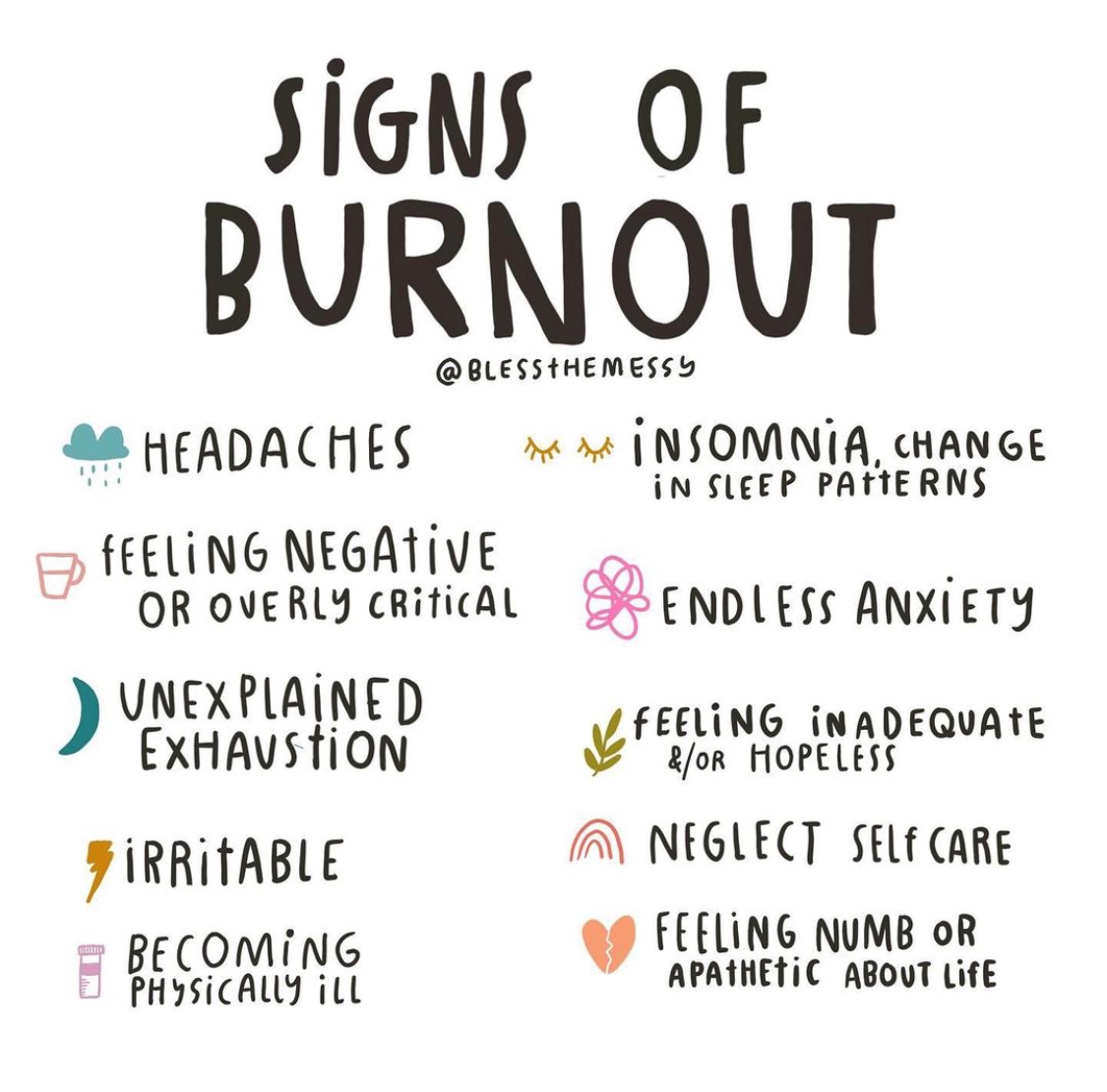
Burnout can manifest as irritability, leading to more frequent conflict with others. It can feel as though we either have too much or too little to do. It can lead to feelings of boredom. Burnout can also feel as though we haven’t the support we need to perform well in any of our roles, be it at work or at home. Burnout can lead to a lack of a work-life balance.

Many who experience burnout report frequent headaches, poor sleep and an inability to care for themselves. Others report that they have lost interest in activities they once enjoyed. Many of the symptoms of burnout are similar to those of depression and anxiety, and if left untreated, can actually lead to depression and anxiety.

It is important to take care of yourself in healthy ways if you notice yourself feeling burned out. It is important to practice good sleep hygiene, meaning going to bed and waking at about the same times every night and day. Most people do well with seven to nine hours of sleep.

It also is important to find healthy ways to manage stress. In addition to getting adequate sleep, it might be helpful to incorporate some exercise into your day. Studies show that at least 30 minutes of daily activity is helpful in warding off stress. Finding time for fun activities also can help with burnout.

Many people also find it helpful to set clear boundaries on their time, energy and space. That may mean having conversations with supervisors about workloads or with family members about care taking responsibilities.

One thing that is helpful to ward off burnout and to find some measure of joy in your life is practicing gratitude, which we have talked about before here. That does not have to mean that you’ve found a zillion dollars in a pot at the end of a double rainbow. It may mean that you enjoyed a really good morning beverage with someone you love. Staying connected with loved ones, be they family or friends, also can be helpful in managing burnout.

Lastly, while it may seem a good idea to comfort yourself with a piece of apple pie or chocolate cake or a venti double-caff, double-whip, double-caramel macchiato, or a three-blue-cheese-stuffed olive martini, that likely won’t help in the long run. What might help is nourishing yourself with healthy foods and staying hydrated with good, old-fashioned water.

Many people are experiencing burnout, especially now that we are in the winter holiday season. It is important to recognize the signs of burnout and to take care of yourself in healthy ways. Yes, self-care may help, but that is only part of the solution. Reach out to a trusted other, supervisor or mental health professional if you feel your symptoms are worsening or becoming unmanageable.

~ Karri Christiansen, MSW, LSW, CADC, CCTP

You can’t self-care yourself out of burnout

What does it mean to practice gratitude?

It seems as though the season of gratitude is upon us, though many people seem to be struggling to find things for which they are grateful. This is understandable, given the current state of the world. Still, if we take the time to look, there remains much to be grateful for.

With Thanksgiving being celebrated in the United States and other places just a few days from now, many people find that they are seeking things for which to express gratitude. Yes, given the state of the world, that can feel challenging. That may mean looking a little harder for things we are grateful for, or perhaps looking a little closer to home.

What does it mean to practice gratitude anyway, and why should we attempt to do so? Well, with everything going on in the world, taking the time to practice gratitude for what is good can leave us feeling less hopeless and helpless, less despair and less depressed. How do we practice gratitude when it seems as though the world has turned upside down. Well, I encourage you to start small.

I often encourage people struggling to practice gratitude to find three small things that are good, that made them smile during the day, or brought them some measure of pleasure. We do not have to think that we can only practice gratitude when we find a zillion dollars at the end of a double rainbow (which likely won’t happen, but maybe you found a penny on the ground). We can practice gratitude for the small things, like our morning beverage, and drill down on that.

For example, today I find myself grateful for my morning coffee, which I shared over conversation with my husband. I am grateful for the electricity I used to brew my coffee and the fact that I have regular, running water to make my coffee. I can practice gratitude for the people who grew my coffee beans and for whomever ground and bagged those beans, and for whomever manufactured my cup. Again, we don’t have to practice gratitude for the big stuff, we can do it for the little stuff, the stuff we sometimes take for granted.

We also can practice gratitude for the people in our lives … even those who think differently than we do or who live differently than we do. With many people gathering later this week around the table for their annual Thanksgiving feast, there are many things for which we can practice gratitude. Even Uncle Mike, whose politics may be different than ours.

Why practice gratitude in the first place? What good will come of it? There is some evidence that those who do practice gratitude on a regular basis are happier and healthier. Some people argue that gratitude is the birthplace of joy and that it’s not happy people who are grateful but grateful people who are happy. Some people find it helpful to write down at some point during the day (maybe over that morning beverage), three things for which they are grateful. Again, it doesn’t have to be three big things like you won a huge promotion with an obscene pay raise. Maybe it’s just that you have the ability to work.

We have 24 hours in a day during which we can find all sorts of things to practice gratitude for. When we do, we may find that our outlook on life may improve even just a little bit, we may feel happier. And when we are happier, we are healthier. Maybe we practice gratitude for that.

What are three things you can express gratitude for today? This week? This Thanksgiving? Who or what made you smile, or even laugh? Where did you find pleasure? What surprised you in a good way? Practice gratitude for that.

~ Karri Christiansen, MSW, LSW, CADC, CCTP

What does it mean to practice gratitude?

When the world seems to be spinning out of control, what are we to do?

Election season is upon us in the United States, leaving many people feeling concerned, frightened, fearful for the future and as though the country is coming apart at the seams. Couple that with climate disasters such as hurricanes, flooding and drought, as well as shootings and violence that seemingly occur on a daily basis, and many people may be feeling as though the world is spinning out of control.

These things, as well as a plethora of others, may leave us feeling as though we haven’t control over much of anything at all. Yes, we can do our part and vote our consciences on or before Election Day. Yes, we can take steps to reduce our carbon footprint and maybe make a small dent in combating climate change. Yes, we can be peaceful citizens and avoid violent confrontations with others. But much of what is happening in the world is well beyond our control. How do we come to terms with what is within and what is outside of our control?

One of the things we can do is recognize that what we do have control over largely is the being reading these words. We can control what we say and do, how we act and behave toward ourselves and others. We can to some extent control what we think and how we share those thoughts and with whom. Other things, though, are likely outside of our locus of control.

We can control how we choose to respond to the goings-on in the world, in our country, in our neighborhoods and communities. We can control how we choose to respond by giving ourselves permission to slow down and think about our next steps. We can control how we choose to respond to things by giving ourselves permission to be kind and compassionate toward ourselves and others. And we can remember that we have little to no control over what others think, say or do. Do we want to respond to whatever is happening with anger, verbal or physical violence? Or do we want to respond with grace and compassion?

Offering ourselves compassion and kindness for our sometimes challenging feelings regarding all that is transpiring around us can help us offer that same compassion to others. It behooves us to remember that while others may think and feel differently about politics, climate change, the Chicago Bears, that does not mean that their thoughts and feelings are invalid. They’re just different. And we can agree to disagree, peacefully, and move on to other subjects of discussion.

If we choose to disagree on a certain topic of discussion, perhaps that means setting healthy boundaries with others, be it friends, family members, colleagues. Healthy boundaries can be agreed upon amongst people, and can be held with compassion. Boundaries teach others how to respect us, and tell others what we will and will not tolerate.

Yes, it may seem as though the world has become unglued. Yes, you may experience challenging feelings about everything that is going on. What are those feelings telling you, about yourself, your values, the things and people you hold near and dear? Check in with yourself. Offer yourself grace and compassion so you can do so freely with others. And, set and enforce healthy boundaries.

~ Karri Christiansen, MSW, LSW, CADC, CCTP

When the world seems to be spinning out of control, what are we to do?