
In just a couple weeks, many folks will be setting their clocks back an hour and many folks may find that the earlier onset of evening leaves them feeling glum. Many folks find that the longer dark hours affect not just their mood but their energy levels and general outlook. For those folks, it’s more than the doldrums; it’s Seasonal Affective Disorder. How do we combat the doldrums or SAD when what we really want to do is hunker down under a bunch of blankets until spring?
Those of us who must set our clocks an hour earlier and who find that the earlier onset of darkness leaves us feeling down, glum, sad, energy-less and unmotivated often find that these feelings persist for several months. And while Seasonal Affective Disorder often strikes during the winter months, some folks find it happening in the summer months. Either way, it is important to pay attention to what your body needs and tend to those needs in healthy ways. Our bodies are a wealth of information if we are paying attention and they will always tells us what they need.
While our inclination may be to hibernate to some extent as the days grow shorter, sometimes what helps most to combat depression, the winter doldrums or SAD is to get moving. Our bodies were made for movement, and while it may seem particularly hard to get going when the days feel so much shorter, movement may be just what we need.
Dialectical Behavior Therapy (DBT) is a skills-based approach to combating depression, anxiety and other mental illnesses. One skill in particular can help remind us to get moving even when doing so seems challenging, if not impossible. Opposite to Emotion Action can help us get moving so that we can get those endorphins flowing so that we feel a little bit better. Opposite to Emotion Action asks us to do the opposite of what we feel. So, when it is cold and dark outside and our sofas and blankets are calling, we can actually do the opposite and bundle up and go for a walk or run or even just walk around our homes for a few minutes. This likely will help us feel a little better. And we know that getting some natural light is a great way to combat the doldrums, depression and SAD.
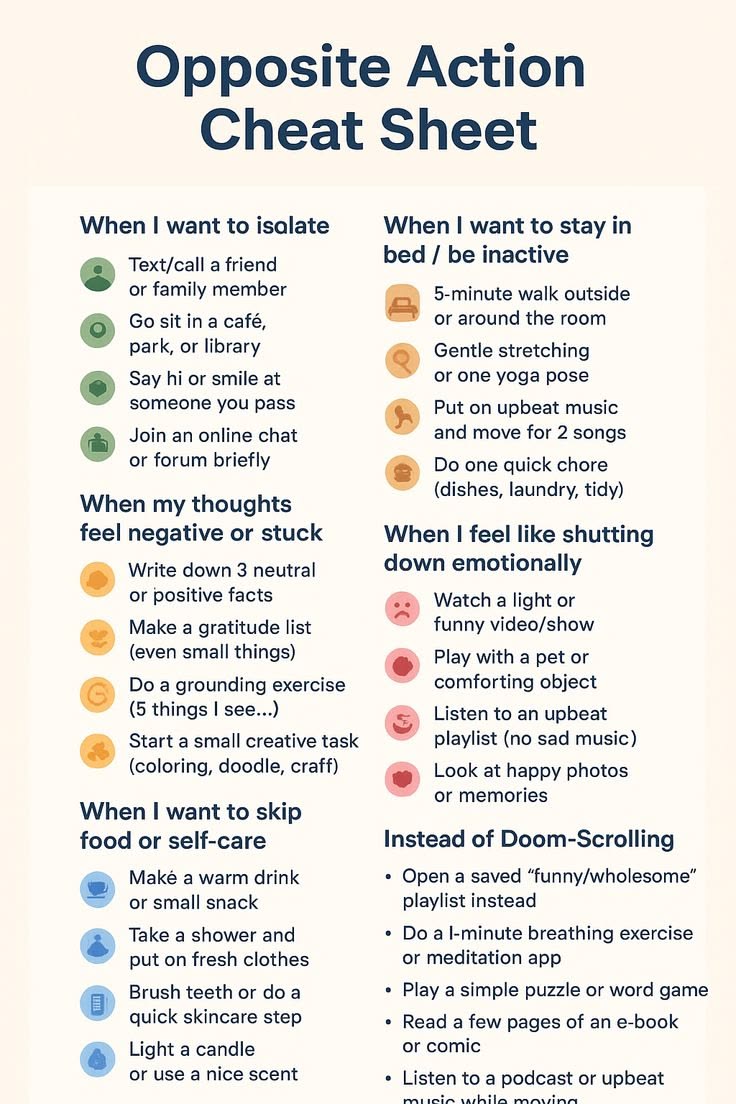
Many folks who live with depression or bipolar disorder or anxiety or SAD feel as though they want to isolate, hunker down under a pile of blankets, skip a shower, doomscroll or otherwise shut down. Doing the opposite of those things may make us feel a little better. Yes, doing the opposite may take a little more energy or time, that is true. Some folks find it helpful to set a timer for five minutes as a way to get moving. That could mean five minutes of dancing or five minutes to take a quick shower or five minutes of meditation or deep breathing or five minutes to load the dishwasher or five minutes to walk around the block or up and down the stairs at home. Perhaps those five minutes turn into 10 minutes or even 20 or 30 minutes.
Shorter days and longer nights leave many folks feeling trapped, especially if the weather is inclement. It is important to maintain healthy habits during this time and that should include getting outside to soak up the natural light, getting movement of some kind, connecting with people in real life, and nourishing our bodies in healthy ways. Maybe that means taking a class or going to the gym, or making time to spend with friends or family in person. It also may be helpful to remind yourself that these shorter days will not last forever and that the days will start getting longer again.
Yes, the shorter days and longer nights may leave us feeling less energetic. If we want to feel better, often what helps is doing the opposite of what we are feeling if what we are feeling is glum, sad or depressed. Yes, this requires some effort. Yes, this may require some time. But if we do not make time for our wellness, we may have to make time for an illness. What can you do to make yourself feel just a bit better today?
~ Karri Christiansen, MSW, LCSW, CADC, CCTP

