Why do we ‘catastrophize?’

The human brain conjures somewhere between 60,000 and 80,000 thoughts per day and some science indicates that upward of 70 percent of those thoughts are negative. Some of those thoughts seem to run away with themselves, catapulting us into worst-case-scenario thinking, or catastrophizing.

What is “catastrophizing,” anyway? Catastrophizing is when we exaggerate the importance of something in a negative way, imagine the worst possible outcome without knowing all the facts, or when we use language that blows something out of proportion. Most of us engage in this kind of cognitive distortion at some point, often as a way to feel as though we somehow are in control over something over which we likely have little or no control. It can be our way of feeling more powerful over a situation, though catastrophizing often leaves us feeling worse and powerless.

We can hear catastrophizing in the way we speak to ourselves and others about perceived mistakes, physical or emotional pain we experience or when we hear bad news. It sounds something like, “I’ll be fired for that mistake I made. I’ll probably lose my house.” “My back is killing me.” “That lump I found means I have cancer and am going to die.” Most of us engage in this kind of thinking at some point, but there are ways to combat it so that we are not left feeling worse.

One way to minimize the damage of catastrophic thinking is to test the veracity of the negative thought. Examine the evidence you have to support the thought, as well as the evidence against it. Ask yourself if you might be jumping to conclusions without having all the facts or if you are overgeneralizing something by using all-or-nothing or black-and-white thinking. We overgeneralize when we assume an outcome based on only one or two past instances. It may be well to remind ourselves that just because something may have happened once or twice in the past, that does not automatically mean it will happen again.

Another way we can minimize catastrophic thinking is to consider what the likely outcome could be. Oftentimes, situations do not see the very worst possible outcome or the very best possible outcome. Give yourself permission to see the possible likely outcome given the facts you have. Try not to bend the story to your negative thinking. Once you have imagined all the possible outcomes, consider how well you would be able to handle the worst possible outcome. What are the chances that you would be okay after a month, six months, a year? Give yourself credit for navigating challenging situations from your past and imagine yourself navigating this one with success.

We engage in catastrophic thinking as a way to feel as though we have some semblance of control over a situation. In fact, this cognitive distortion often leaves us feeling more powerless. Search for the facts, find the answers and test the veracity of your negative thoughts. It may be helpful to remind yourself that most of us engage in negative thinking; that is only human. But, we can restructure our negative thoughts by examining the evidence we have to support them.

It also is important to remind ourselves that not only do most of us engage in negative thoughts, often when we do so when we are in the midst of struggle. As Brene Brown says, what we do not need in the midst of that struggle is shame for being human. It is well to remember to offer yourself some compassion for what you are going through and to remind yourself that struggle is part of the human condition. We all struggle but we can give ourselves the power to overcome the struggle by avoiding catastrophizing.

~ Karri Christiansen, MSW, LSW, CADC, CCTP

Why do we ‘catastrophize?’

The victim role is uncomfortable, but how do we abandon it?

We all have encountered folks who seem to find it challenging to find the good in any situation, person or experience. We all have encountered folks who seem to feel as though they constantly fall prey to the worst life has to offer. How do people fall into the victim role? And, what can be done about it?

I suspect those in the victim role are fairly unaware that that’s where they are in life. I suspect that they may notice that it feels as though nothing goes their way, that nothing seems to work out for them or that people seem to be acting with malicious intent. But what if some of what folks who find themselves in the victim role actually have more going for them than they realize?

How do we know if someone has become comfortably uncomfortable in the victim role? These folks tend to not look forward to the future, share the same negative stores, anecdotes or experiences with some frequency, engage in self-pity and seem to exude a sense of entitlement. People who are in the victim role often are defensive and are not open to criticism and often blame others when things go haywire or not their way. Folks in the victim role tend to complain often and reject other views. Those in the victim role tend to be risk averse and obsess over negative situations while being uninterested in solutions. They tend to find themselves in a place of judgement, which often stems from places within themselves that are not healed.

Folks who seem to be in the victim role also may find it difficult to trust others and often assume that others act with malicious intent, purposefully trying to hurt them. This can be the result of trauma. Their maladaptive behaviors often are learned over the course of years, if not decades. And while these behaviors may have helped them survive trauma, at some point they have become so ingrained that they have rendered the person unable to see the good in anything.

So, how does one move from being in the victim role to being a victor in one’s own life? Therapy is an option for many folks who find themselves in the victim role, as long as they are willing to do the work of therapy.

The first step, though, is taking responsibility for one’s own life. That may mean processing trauma with the help of a trained mental health professional. It also means that we have to accept the part we played in our past. That does not mean we acquiesce to the fact that we were traumatized in some way, but it does mean that we are responsible for choosing to heal from that trauma.

Moving away from the victim role also requires us to take steps to feel empowered and to develop a sense of self-efficacy. This helps combat any learned helplessness that keeps us from engaging in activities we may actually end up enjoying. It also helps us to realize that we are stronger than we give ourselves credit for. We can be the victor of our own life if we choose to believe that we are powerful. That does not mean, however, that we use that power over others. That means we use that power to improve our own lives, ourselves. It means we take responsibility to learn, grow and become better versions of ourselves.

Becoming better versions of ourselves requires that we practice self-compassion, speak kindly to ourselves and treat ourselves with the same respect we would want others to show us. It can be challenging to move away from the victim role if we do not treat ourselves with the same respect we would want from others. Similarly, when we offer ourselves compassion, this empowers us to view ourselves in a different light. Doing so will help us view others and the world not as malicious but as kind and open-hearted.

Becoming better versions of ourselves also seems to ask that we start seeing the good in people and in situations, rather than the bad. It asks that we see the sliver lining more often than we focus on the dark cloud. There is good in the world, and the more we focus on that, the easier it is to abandon the victim role and become the victors of our own lives.

~ Karri Christiansen, MSW, LSW, CADC, CCTP

The victim role is uncomfortable, but how do we abandon it?

Meditation is fraught with misconceptions

Meditation has become more and more popular of late, thanks in part to several apps that offer low-cost or free options to countless people. But, what is meditation and does it really involve having to completely clear one’s mind? The answer, simply, is not exactly.

I frequently find myself encouraging clients to consider meditation as a way to ease stress, anxiety and worry. But meditation also can be used as a way to give oneself time to rest mentally, which is particularly important these days, with what seems for some a constant assault on our senses. This is particularly helpful for those with stressful work or home lives, but really can be used by anyone. Some meditations or mindfulness practices encourage loving kindness, which, as many of us know, is helpful in what seems an ever-increasing hostile world.

What is meditation, though? Meditation is time spent quietly, thoughtfully, and requires practioners not to clear their minds but to be present with all that is, well, present. That may be sounds or people or what have you. Meditation asks us to simply accept what is around us and to be okay with all that is present. We do not have to clear our minds for the duration of the time spent meditating; that is nearly impossible. Most humans have upwards of 75,000 thoughts a day. We cannot be expected to simply clear our minds for a great span of time. Meditation simply asks us to be okay with whatever is present, to focus on a sort of home base, such as the breath or a quiet sound such an air vent or heater, or nature sounds, for a specific period of time, a few minutes to an hour.

I started meditating about two years ago and do so with some frequency. I have found that over the course of these two years, meditating regularly has allowed me to practice self-compassion with greater ease and to practice loving kindness toward others more frequently. This is not necessarily the goal of meditation, but it certainly can help in today’s world. Meditation also allows some people a chance to be still, to rest their minds and to simply rest and to just be. In our ever-so-busy lives, who would not benefit from three, five, 10 or 15 or even 60 minutes of peace and quiet and time to just be?

It may seem to some as though you do not have even a few minutes to spare to meditate. It may seem as though there is not enough time in the day to simply rest and just be. I may argue, though, that the time spent meditating, resting, just existing, affords us an opportunity to better tend to the tasks that we need to complete, be they at work or in our personal lives. Meditation can help us be better people for the people around us.

Meditation is not the answer to stress, anxiety or worry in our lives, but engaging in meditation can help us be better able to manage those feelings. Meditation affords us an opportunity to be okay with whatever is present in our lives, be it good or not so good. Mediation allows us a chance to rest and reset so that we are better able to handle whatever comes next.

Some smart watches and fitness trackers offer access to meditation apps such as Calm or Headspace, and those applications are available through most play stores. However, one can practice meditation by simply sitting quietly and focusing on the breath or another pleasant sensation, or by focusing on pleasant sounds such as birds singing or leaves rustling. The time you spend meditating is not wasted time; it’s time that affords you an opportunity be a better version of yourself.

~ Karri Christiansen, MSW, LSW, CADC, CCTP

Meditation is fraught with misconceptions

We are more than our thoughts and feelings

Human beings are complex creatures. We are comprised of bone and muscle and skin and hair. We are humans because, in part, we are capable of higher thinking and recognizing our emotions and feelings. But we are so much more than our thoughts and feelings.

If you think about it, our thoughts and feelings are like visitors; they come and go and rarely stay forever. Sadly, many of us struggle with the notion of letting go of certain thoughts and feelings, be they recurrent or perplexing. It can feel challenging to recognize a thought as, well, just that. A thought is just a thought. Just as a feeling is just a feeling. Some folks, though, tend to lean into their thoughts and feelings, leaving them open to the possibility of over-identifying with those thoughts and feelings.

It is so important to choose our words carefully when describing not just what we are thinking, but what we are feeling. If we use words that open us up to over-identifying with a thought or feeling, that can lead us into anxiety or depression. It may sound like a matter of semantics, but words really do matter.

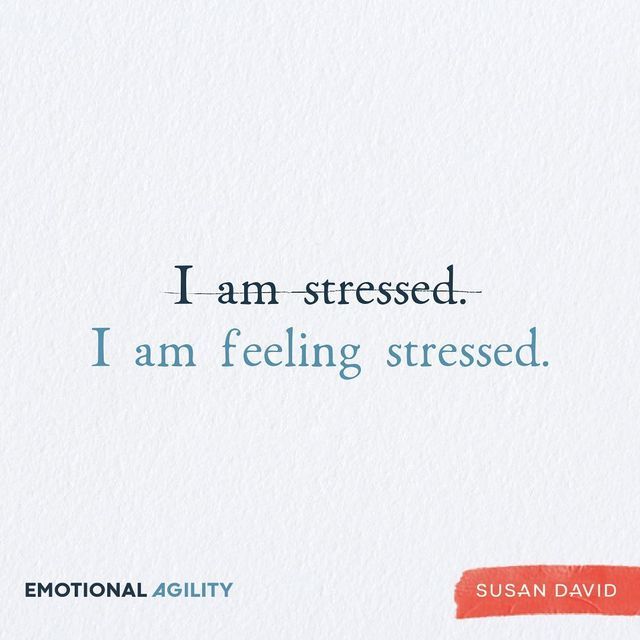
Susan David, PhD., author of “Emotional Agility: Get Unstuck, Embrace Change and Thrive in Work and Life,” encourages us to consider creating space between our thoughts and feelings by using words to do so. For example, instead of thinking or saying, “I’m so stressed.” We instead can think or say, “I notice that I am feeling stressed.” The latter statement reminds us that “stressed” is just a feeling that likely will pass at some point.

We can give ourselves the power to step back from our feelings, whatever they may be, but particularly with those that are more challenging, by choosing to reframe the way we think about and verbalize our feelings. We can feel more in control of our thoughts and our thoughts about our feelings when we give ourselves permission to examine them more closely.

David goes even further, reminding us that feelings are neither good nor bad, positive nor negative. Yes, some feelings may seem somehow harder to manage, but again, most feelings are temporary. Rarely are we left with a feeling that lasts our entire lifetime. We can choose to not over-identify with our feelings by using language that creates space between us and our emotions. This may require us to slow down and really think about what it is we are feeling and use accurate words to describe our emotions. Doing so also gives us time to choose how we want to react to those feelings and decide what we want to do about those feelings.

Slowing down and really giving ourselves time to think about what exactly it is that we are feeling can leave us with the sense that we are more in control of not just our emotions, but our reactions to them. This can be handy in times of stress or anger, but doing so also gives us permission to recognize feelings of happiness, joy and awe.

Humans are amazing beings. We have evolved over millenia to be able to entertain complex thoughts and ideas but we also are capable of intense feelings and emotions, some of which may feel difficult to navigate. Allowing ourselves permission to step back from some of those more challenging feelings can help prevent us from over-identifying with those feelings. After all, we are more than our thoughts and feelings.

~ Karri Christiansen, MSW, LSW, CADC, CCTP
We are more than our thoughts and feelings

Why is “rest” so hard for some of us?

For so many of us, it can feel as though there are constant demands on our time, energy and attention. From tending to work obligations, engaging socially, practicing hobbies, exercising, taking care of family and friends, the demands we face may at times seem endless. It is important to remember that it is perfectly acceptable to rest from time to time.

That word, “rest,” for some may seem daunting. It seems as though many people equate the word “rest” with being lazy. Giving ourselves permission to rest from time to time is far from being lazy, it is necessary so that we can perform at our best at work, at home and in our personal lives. But getting some rest means more than just getting sleep. There are seven types of rest many of us need to feel refreshed, recharged and rejuvenated.

The seven types of rest are physical, mental, emotional, sensory, creative, social, and spiritual. Each type of rest impacts a different part of our lives. All are necessary from time to time, and taking time to rest in one way or another does not mean that we are lazy. It means that we have given ourselves permission to take the time necessary to tend to our own needs so that we may be better able to care for those we love.

Physical rest means more than just sleeping, which is important unto itself. Physical rest can mean taking a day off from our exercise routines and just relaxing, which can be challenging for some people. It is important to remember that even elite athletes take rest days.

Sensory rest is important because for many it seems as there is a constant barrage of light and noise, dings and pings of notifications, constant sounds from televisions and radios and so forth. One way we can engage in sensory rest is to give ourselves permission to disengage from our devices, be it our phones, our tablets, our computers, our televisions or radios and simply just be. It is okay to sit in silence for a while and just breathe.

Emotional rest can mean reaching out to a trusted other to share your thoughts and feelings, or it can mean spending time alone in a place that gives you pleasure. That could mean taking a solo hike or walk in nature or being in a calm, quiet room.

Spiritual rest could look like taking a break from the spiritual demands we face on what can feel like a near-constant basis. Maybe that means praying or meditating quietly or maybe it means practicing yoga.

We all need mental rest, and for many that can mean unplugging and taking a break from the world. It seems more and more, we constantly are facing some kind of stimulation, whether wanted or unwanted. Taking time for mental rest can mean being away from the world in whatever way feels good and healthy, even for a short while.

Creative rest for some could mean letting go of the need to feel as though we must be productive all day, every day. There is something to be said for doing absolutely nothing. For others, creative rest could mean taking time away from the demands to be productive and simply work on something that brings you pleasure.

Many people need rest from the social demands we face on what seems a constant basis. While many of us are social creatures, many of us also need time to just be by ourselves, especially those among us who are more introverted. There is nothing wrong with turning down an invitation and simply spending time by yourself engaging in something healthy that brings you joy.

Taking time to rest your body, mind and soul does not mean you are being lazy. Doing so is imperative if we want to function at our best and be there for the people we love. We all need rest. What type of rest might you be needing? Can you give yourself permission to listen to your mind and body and take the time to rest?

~ Karri Christiansen, MSW, LSW, CADC, CCTP
Why is “rest” so hard for some of us?

Self-compassion is not a radical notion … is it?

In recent months, I have worked with several people who seem to struggle with the very idea of being kind to themselves. I have had discussions that have been close to arguments with people about the concept of self-compassion, what that means and when to apply it. Why is the idea of self-compassion so difficult for some people to grasp?

It seems as though part of the problem with understanding the idea of self-compassion is that some people seem to equate it with being lazy (I hate that word) or with letting themselves off the hook for real or perceived transgressions. This, to me, begs the question of whether it is possible to be both kind to ourselves and to hold ourselves accountable at the same time. Self-compassion can be likened to speaking kindly to ourselves, offering ourselves the same grace and compassion we might a family member or friend when a mistake or error is made. For some, though, the idea of doing so seems so foreign that it is nearly impossible to understand.

Kristen Neff, PhD, author of the book “Self-Compassion: The Proven Power of Being Kind to Yourself” defines self-compassion as “being warm and understanding toward ourselves when we suffer, fail, or feel inadequate, rather than ignoring our pain and flagellating ourselves with self-criticism.” In other words, self-compassion does not sound like self-shaming or berating ourselves for making a mistake. We all mistakes. That’s what makes us human.

Some people have argued with me that offering ourselves self-compassion for any real or perceived missteps on any sort of regular basis will leave us with narcissistic tendencies or inflated self-esteem or inflated egos. Likely more than not, what will happen is that we find when we are better able to practice self-compassion, we will be better able to offer others compassion, as well.

Offering ourselves and others compassion does not mean that we let ourselves off the hook for making an error. It means that we accept the fact that making mistakes is part of the human experience. We can lament our mistakes and beat ourselves up for being human, or we can choose to learn from our mistakes, apply those lessons in the future and move on. We cannot nor should not fault ourselves for being human.

For some, though, this concept seems difficult to grasp. Some people seem to believe that engaging in negative self-talk and self-flagellation is the only way to learn from our mistakes. I beg to differ. Engaging in self-shaming, negative self-talk rarely moves us toward feeling better about ourselves and rarely serves as motivation to do better. We cannot shame ourselves into self-compassion or self-love. We can, though, speak kindly to ourselves and vow to do better in the future. Growth does not stem from negativity.

So, what does self-compassion sound like? It sounds like the same caring responses we might offer a friend or family member who has made a mistake or error. It sounds like, “Hey, you’re doing the best you can with what you have right now.” It sounds like, “Making a mistake does not usually mean the end of the world. What lesson can you glean from this?” It sounds like, “You know, we all make mistakes. That’s part of the human experience.”

Practicing self-compassion more likely than not will not end up in us becoming narcissists or lazy or what have you. Practicing self-compassion likely will leave you feeling better about the possibilities of learning from your mistakes, applying those lessons moving forward and offering compassion to others when they make mistakes. We all are human beings, doing the best we can with what we have right now. We all make mistakes. We can choose to learn from them and move on, or we can choose to beat ourselves up for being human and feel badly about ourselves. The choice is yours.

~ Karri Christiansen, MSW, LSW, CADC, CCTP
Self-compassion is not a radical notion … is it?

Asking for help is not a sign of weakness

I have found myself recently wondering why it seems so daunting for some people to ask for help, of any kind. What is it that makes asking for help seem so frightening? There are many reasons behind why some people find asking for help so uncomfortable.

One of the reasons some people may find it challenging to ask for help is that they do not want to be perceived as weak. When we assume that whomever we are asking for assistance will see us as weak, however, we may be coming from a place of shame. Perhaps asking for help was frowned upon when you were a child. Perhaps you were told at some point that the only way to learn something was to go it alone. Perhaps you internalized a message that taught you that asking for help meant that you were stupid or unworthy. These sorts of messages can leave us feeling as though asking for help, of any kind, is bad or wrong. It may be helpful to remember that none of us can get through life without asking for help at some point. Asking for help does not mean that we are weak, bad, stupid or even codependent. We as humans are interdependent. We rely on others to get through life, and that is okay.

Another reason we may shy away from asking for help is because doing so leaves us feeling vulnerable. That feeling of being vulnerable for many can be uncomfortable and even a tad painful for some. Brene Brown reminds us, though, that vulnerability is our most accurate measure of courage. It takes more courage to ask for help than it does to suffer in silence. Asking for help is a sign of strength.

Another reason some people may be hesitant to ask for help is because they fear rejection. None of us likes feeling rejected; it hurts. One way to lessen the chance that our seeking help will be met with rejection is to be clear about what we need and what we need to meet that need. It is okay to use statements such as “I feel X when Y happens and what I need in this moment is Z.” When we are clear about what we need and how we would like that need met, it can be easier for those from whom we are seeking help to meet that need.

Asking for help is not always easy. It may be helpful to remember that while seeking assistance can feel daunting, doing so may actually be less painful than suffering alone. We as humans are wired for connection. We need others to navigate the sometimes troubling waters of life. Remembering that none of us is expected to get through life without assistance may help us feel better about asking for help.

~ Karri Christiansen, MSW, LSW, CADC, CCTP
Asking for help is not a sign of weakness

Boundaries teach others how to respect us

I find myself frequently thinking about boundaries, not just in my professional life, but in my personal life, as well. I am reminded that boundaries are needed to help others learn how to respect us. The question is, though, how do we set and enforce boundaries, particularly in toxic relationships?

In the past several weeks, I have encountered several people who have found themselves in toxic relationships and are noticing how challenging it can be to set and enforce boundaries. It can be difficult to set boundaries with people in our lives because we do not want to step on anyone’s toes or hurt their feelings. I understand that. However, boundaries often are needed in relationships, particularly those that have become toxic, so that the people with whom we are having a relationship can better understand just what we will and will not tolerate in terms of behavior. Setting and enforcing boundaries is crucial if we want to teach others how to respect us, our time, our energy and our love.

Setting boundaries with people, toxic or not, does not mean that we do not care for those people. On the contrary, doing so shows others how much we care for them and for ourselves. If we do not set and enforce boundaries, we may run the risk of inviting people to disrespect not just our feelings but our values. But how do we set boundaries?

4 tips to set boundaries and maintain them with toxic people

  • Know your limits. What are you willing to tolerate?
  • Communicate boundaries clearly and assertively.
  • Don’t make excuses for others’ behavior.
  • Be willing to walk away from the relationship.

It may feel awkward at first setting boundaries with those people about whom we care. It may be helpful to remember that those who seem unable or unwilling to respect our boundaries may not be our people. If you try and try again to enforce boundaries, and those boundaries are ignored or pushed, it may be time to re-evaluate that relationship. Is it time to end the relationship? And if so, what steps are you willing to consider to keep that person out of your life. It may seem as though you are not to the point of deleting that person’s number from your phone, blocking that person or unfollowing that person on social media. Perhaps that is exactly what is needed.

Ending a relationship with someone who does not respect your boundaries, your values or your feelings may leave you feeling some measure of grief. You may find yourself grieving the loss of the relationship and/or the loss of what that relationship could have been. Try to remember to be kind and gentle with yourself as you move through that grief. Try to remember that your feelings, needs, values, hopes, wants and desires are just as valid as anyone else’s. Try to remember that you are worthy of love and belonging simply because you are human. Try to remember that although the relationship you are grieving did not work out, that does not mean you are unworthy of a healthy relationship.

When considering a new relationship, be it platonic or romantic, try to remember that it is acceptable to make your boundaries known at the start of the relationship so that whomever you are becoming involved with knows exactly what you are willing to tolerate and what you will not.

Setting and enforcing boundaries is an important step in any relationship, but particularly those that have become toxic. We all deserve to be in healthy relationships, be they platonic or romantic. Offering excuses for the person who is disrespecting you invites more poor behavior and can leave you feeling badly about the relationship and about yourself. Putting boundaries in place shows others that you respect yourself enough to state clearly what is and what is not acceptable. Are there people in your life with whom you need to set boundaries? What steps might you be willing to take to put those boundaries in place?

~ Karri Christiansen, MSW, LSW, CADC, CCTP
Boundaries teach others how to respect us

Is social media fueling the loneliness epidemic?

Ask most experts, including U.S. Surgeon General Vivek Murthy, and you will discover that we are in the midst of a loneliness epidemic. Many of us feel lonely from time to time and many of us have felt even more lonely since the start of the COVID-19 pandemic when so many of us were sequestered in our homes, away from family and friends. But what breeds loneliness and how can we combat this often painful feeling?

Experts tell us that one of the things adding to our feelings of loneliness and disconnection is our use of social media. Yes, social media can offer us a quick way to catch up with people we care about but it also can leave us feeling even lonelier, more disconnected and more dissatisfied with our lives. What often happens to some folks who find themselves scrolling social media for any length of time is social comparison, which is comparing our lives to what often is the highlight reels of those who post on social media. When we engage in social comparison, we may start to feel as though our lives are not as fun, exciting or happy as others’ lives. This may leave us feeling lonely, sad and disconnected.

Social media can be a fun and even useful way for us to stay in some way connected to people with whom we might not otherwise engage, but what would happen if instead of scrolling for what for some can turn into hours at a time, we actually reached out to those we follow on social media? Instead of liking or commenting on a friend or family member’s post, perhaps consider calling, texting or video chatting with that person. Perhaps consider scheduling a get-together with people, something that happens live, in real life. And then make that get-together a device-free outing.

One of the things adding to our feelings of loneliness and disconnection stems from sitting next to someone in real life, with one or both of you with your heads down, buried deep in your phone or tablet, voraciously consuming social media. If you want to feel connected to whomever it is you are with, put your device away, turn to your people, make eye contact and engage in conversation. Social media will be there later.

Social media has become such a pervasive part of our lives. Many of us use some platform and many of us turn to social media when we feel bored, lonely or disconnected. Remember that it still is acceptable to reach out to those we care about and engage them in actual conversation. We can still use our cell phones to make phone calls. Remember, too, that social media can leave us feeling even more disconnected, so it is okay to limit your use to an hour or less per day. Some people find it helpful to set a timer for 15 or 20 minutes and then get off whatever platforms that are being used.

It also may be helpful to really think about who you may be following on social media. If you frequently find yourself engaging in social comparison with a particular person or group of people, consider unfollowing or blocking that person or group. It also may be helpful to leave positive comments for those you do want to engage with rather than simply using an emoji to react. Remember, though, that comments should be positive or helpful, rather than negative. There already is so much negativity on social media, it is important to distance yourself from that if you want to see improvements in your mental health.

Social media can be a useful tool to stay in some way connected to those you care about, yes. If you find yourself spending time on social media that leaves you feeling more disconnected, lonelier and badly about yourself and your own life, it may be time to rethink not just how much time you spend on social media, but who you follow, how you engage and what platfoms you are using.

If you really want to combat feelings of loneliness, reach out to trusted others, be they family or friends, and schedule a time to meet in person or via video chat. Remember that these gatherings can and should be device free if you really want to connect. Feeling lonely can leave us with sadness and depression, as well as anxiety. Remember that even in this age of social media, there is nothing wrong with actual, live human-to-human contact. Social media can wait.

~ Karri Christiansen, MSW, LSW, CADC, CCTP
Is social media fueling the loneliness epidemic?

What does it mean to age “gracefully?”

At the risk of stating what to many likely seems obvious, getting older is not easy. Aging is hard, regardless of what your age is. Many of us live in a society where aging leaves us feeling more and more left behind, left out or even invisible. This seems particularly true in the United States, where our elderly often are regarded with some measure of disdain. So, how do embrace aging, as it is, after all, inevitable.

In the United States and elsewhere, both men and women are often bombarded with images and advertising urging us to use “anti-aging” this, that or the other thing. We are encouraged to fight wrinkles and cover up graying hair. We are told that once we reach a certain age, we likely will lose our vitality and be more prone to illness and injury. We are told that we cannot keep up with technology and we sometimes may feel as though the world is moving so fast, we truly cannot keep the pace. But there are steps we can take to embrace our advancing years, regardless of whether we are turning 30, 40, 50, 60, 70 or older.

One of the things we can do to embrace our age is to remember and be thankful for all our bodies continue to allow us to do. Yes, we may no longer be able to run or walk as fast or as far as we used to or shoot hoops with the young folks at the gym without getting winded, but that does not mean we have to give up physical activities or our favorite sports. Be grateful for what you can still do and embrace the possibility of considering different kinds of movement. Perhaps we may not be able to run marathons as we enter a new decade but perhaps we can run half-marathons, 10ks or 5ks. The point is to keep moving. Maybe that means more gentle movement such as yoga or tai chi or walking. Regardless of what activity or sport you enjoy, remember that it is okay to be thankful that your body continues to allow you to move, even if perhaps that movement is different now.

Aging gracefully also means that we can and should be kind and compassionate with ourselves and others as we may find ourselves entering new phases of our lives. Can you be patient with yourself as you navigate what seems like ever-changing technology? Would it be helpful to take a class about computers or cell phones so that you can keep up with the younger folks in your life? Perhaps a friend or family member may be willing to show you around your cell phone so that you can keep up with family and friends via text and video chats. Perhaps you could find a tutorial about how to use the webcam on your computer so that you can Skype or FaceTime with your friends and family. The more we give ourselves permission to seek assistance with ever-changing technology, the less we may feel left behind or left out.

As we age, we may notice relationships changing or that our friends and family are either moving or perhaps dying. It is particularly important as we age to maintain not just our romantic relationships, but our platonic relationships, as well. That may mean reaching out to friends more often and scheduling get-togethers with those who are important to us. We are in an epidemic of loneliness as some may find that the older we get, the more isolated we feel. That may mean finding new and creative ways to forge new connections. Maybe that means joining a book club or gardening club. Maybe that means volunteering for a cause you find important. Maybe that means tutoring younger folks or teaching driver’s ed. Whatever you do, remember that we are wired for connection and our relationships, be they romantic or platonic, need tending to even more so as we age.

For some of us, aging means coming to terms with our changing appearance. We may start to feel as though our appearance is not what it once was and that can leave us feeling anything from sadness and grief to shame and fear. Some of us may feel that our bodies have somehow betrayed us as we notice our mid-sections expanding and our muscle tone changing. Some of us may notice more wrinkles and gray hair as we age. These are not signs that our bodies are failing us. These are signs that we are in the midst of change. And change does not have to be viewed with fear or sadness. There is beauty to be found in all faces and bodies. Perhaps it may be helpful to focus on those parts of you that you do find beautiful. Perhaps it may be helpful to eschew society’s definition of beauty and embrace your own unique beauty. And, again, try practicing self-compassion when you look in the mirror. Our bodies at 50, 60, 70 or older may not look the way they did at 20, 30 or 40. That does not mean we are not beautiful. It just means we are entering a new phase of our life.

We can choose to embrace aging as a natural, normal part of life by practicing gratitude for our changing faces and bodies, being thankful for what we still are able to do. We can embrace aging by seeking assistance with technology so that we can better keep up with life, our family and friends. We can embrace aging by tending to both our romantic and platonic relationships. We can embrace aging by practicing self-kindness and self-compassion, and by extending that same kindness and compassion to those around us.

Aging is not easy. It does not matter if you are in your third, fourth, fifth, sixth, seventh decade or beyond. What can you do to age with grace? What steps are you willing to take to feel your best as you age? Aging with grace is possible, if we only give ourselves permission to do so.

~ Karri Christiansen, MSW, LSW, CADC, CCTP

What does it mean to age “gracefully?”