
I have been hearing from many people both in my professional life and personal life that feelings of resentment have been building for years, forming a wall that is nearly impossible to see over and leaving folks feeling hurt, betrayed and disconnected. Resentment is like a wall, that, if not addressed sooner rather than later, can be challenging to knock down.
While many folks may harbor feelings of resentment, many often feel as though the time has past to say anything about what caused the feeling of resentment in the first place. Resentment tends to grow over time, so if not addressed those feelings tends to fester, leaving us feeling bitter, disconnected and angry. When we think of resentment as a wall that can, at times, feel hard to even see over, we think about what that wall is comprised of. Each time we let something slide that bothers us, that upsets us, leaves us feeling concerned, or leaves us feeling angry, we forge a brick in that wall of resentment. If you find that happening in one of your relationships, be it with a partner, a sibling, a parent, or a friend, that may mean that it is time to say the thing that needs to be said.
I understand that sometimes it is difficult to speak to someone about something that has bothered us for even a minute, or for days, weeks, months, or even years. Not many people are overjoyed to engage in those often challenging conversations. But what happens when we let things go unsaid, is that we forge another brick in the wall of resentment. When that wall becomes too high, it makes it difficult to even see the person on the other side without also feeling that resentment.
So, how do we engage in these conversations? How do we even open that conversation? What some people find helpful is having a “Hey, this is what I’m noticing … this is how it makes me feel … what are we going to do about it?” conversation. Of course, timing matters. If the person you need to speak with just got home from a craptastic day at work, maybe choose another, calmer time, to have this conversation. Maybe the conversation needs to happen the moment that pang of resentment is felt, so that feeling does not become yet another brick in the wall of resentment.
In addition to speaking with kindness with the person toward whom you feel resentment, there are additional ways to let go of feelings of resentment. Let’s take a look at some of them.
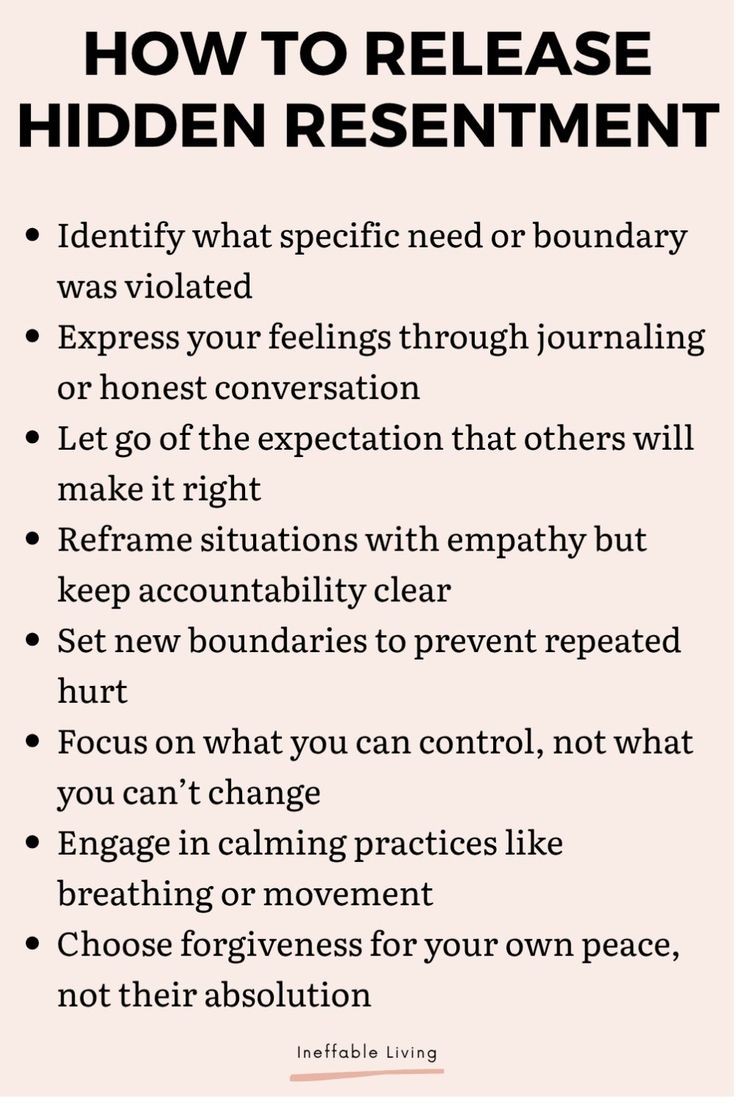
First, try to remember that boundaries are important in any relationship. It is crucial to set and enforce boundaries so that we let another person know what we will and will not tolerate, what our needs are and how we need them to be met, and to teach other people how to show us respect. Many times, folks who have trouble setting and enforcing boundaries find themselves with deep feelings of resentment. This could be due, to some extent, to never having had set boundaries in the first place. If you find that your boundaries are not being respected, it is time to say what needs to be said about that, in a kind and caring way. Share your feelings about the boundary, what need it addresses and how you want to get back on track with the boundary.
Try to remember that most people do not engage in malicious or intentionally disrespectful behavior. Yes, it may feel as though some behaviors are intentional, though likely more than not, those behaviors were not meant to cause pain or consternation. It is okay to share your feelings about the behavior without launching a personal attack on someone’s character or personality. Doing so holds the other person accountable for their actions while allowing you to share your feelings and needs. The other part of this is offering the other person forgiveness for what may have been a bad choice, a confusing action, or hurtful words. Forgiving a person for a misdeed or misstep does not mean you are excusing the behavior, but rather can offer you some measure of peace.
Sometimes journaling can help folks let go of some of their feelings of resentment. Using an actual writing utensil and a journal or piece of paper can help the writer release feelings, often more so than typing it out on a note on your phone or computer. In writing things down, we can give ourselves permission to look at things more clearly, from another person’s perspective, and focus on what we have control over and what we do not. While we cannot control another person’s behavior or words, we can gently point out when we feel harmed or hurt by those behaviors or words. Say the thing that needs to be said.
When we let a moment pass to say what needs to be said, we begin to forge a brick in the wall of resentment. Repeatedly allowing this to happen can lead to feelings of hurt, anger, betrayal and disconnection with our person, whomever that may be. If we can summon the courage to address things head-on, say what needs to be said, we can start taking down that wall of resentment brick by brick. Sometimes that wall gets so high, we completely lose sight of who the other person is or was. We let our feelings of resentment blind us.
Is there something you need to say to someone? Can you find the courage to have a “Hey, this is what I’m noticing … ” conversation? Try to remember that if we are not sharing our feelings of resentment and why they are there, the other person may be completely in the dark about our feelings, left to wonder what the heck is going on. Say the thing that needs to be said, kindly, gently, and with the understanding that the other person may have no clue as to why you feel resentment toward him/her/them.
Karri Christiansen, MSW, LCSW, CADC, CCTP
 phoenixrisenblog